

Firstly. The Olivet Discourse—Matthew 24
Preface: The previous Chapter 23 of is critical for it is the lead-up to the Olivet Discourse. For example, Jesus’ prophecy that their leaders will persecute those he will send and the terrifying prediction that “upon you may fall the guilt of all the righteous blood shed on earth . . . . . . Truly I say to you, all these things will come upon this generation” (vs.34-36). As you know, there are no chapter divisions in the original texts. It is a continuous narrative. Matthew 23:13-36
The Olivet Discourse was addressed to four of the twelve apostles at a particular point in time and place. It was not addressed to disciples beyond that generation, let alone to today’s readers.
We must resist the all too common habit of applying Jesus’ words to us, as if he was speaking to 21st-century readers about our future. We are edified by discerning how the truth of the gospel applies to us today. There are many words recorded as spoken by Jesus to his disciples which cannot apply to us today. God gave us scriptures for us but they were not written to us!
It is very important to realise, as scholar N. T. Wright wrote, “Jerusalem remained the focal point of everything that the Jews were and did. Jewish identity was bound up with, and focused upon, a single city, and within that city a single shrine.” Jerusalem Past & Present in the Purposes of God.1994.
Turning now to the text of Matthew 24 – please read the text and read it again.
The discourse must be seen as Jesus answering the disciples’ two questions—when these things will happen and what will be the sign of His presence. This text flows continuously without any breaks The central issue is Jesus’ coming in judgment on Israel and its Temple which no longer was fit for his presence and his coming presence (Parousia) among a new ‘nation’ of the elect people of God.
Jesus gives many prophecies: see vs 2, 5, 6, 7, 8, 9, 10, 11, 12, 14, 15-23, 29, 30, 31, 33-34.
The numerous time stamps show that the narrative is a unity. See vs 8, 10,29, 30.
Several verses show that the scene is local, Judean, not worldwide. See vs 1-3, 16-22, 30.
Several verses talk about ‘The End’—see vs 3, 6, 13, 14
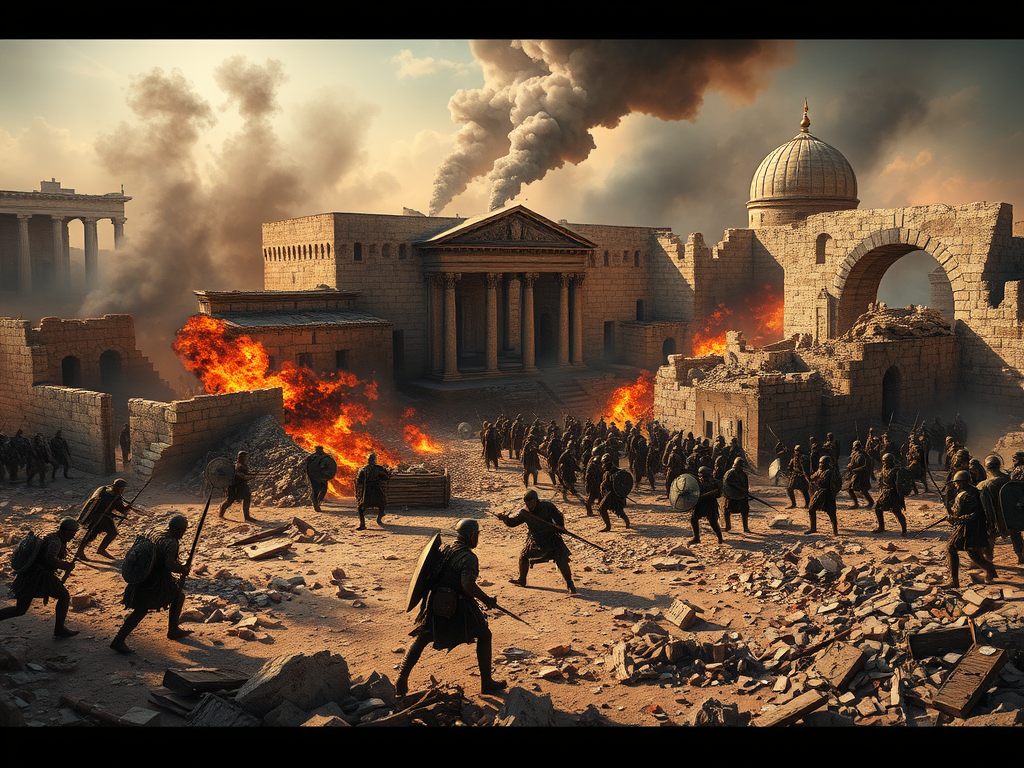
The visible destruction of Jerusalem and its temple will be the sign that the Son of Man reigns in heaven having ascended to the Father. Jesus prophesied that natural, fleshly Israel, with its temple worship, sacrificial system, priesthood, all will disappear.
The great judgment Jesus has described would come upon Jerusalem, its leaders, and its temple within that generation, and vindicate Jesus and his followers as the true Israel.
Secondly. The reports from early historians
Jesus’ coming would be marked not by his visibility, but by much visible phenomenon, e.g. storm clouds hiding his glory, Psalm 18:6-16. Remarkably, Josephus, Eusebius, Tacitus and the Talmud variously recorded that trumpets and angelic voices were heard and supernatural activity observed around the time of the end of Jerusalem and its temple—this is ancient history.
Tacitus
The Roman historian reported, “sudden lightning from the clouds lit up the Temple. Histories ch. 5 sect. 13 AD 109 and “In the sky appeared a vision of armies in conflict, of glittering armour.”
Josephus
Josephus, who had probably never heard of Jesus’ prophecies and who would have done nothing to show its fulfilment, records the signs which He says preceded the destruction of the city.
A star, says he, resembling a sword, stood over the city, and a comet that continued a whole year.
At the feast of unleavened bread, during the night, a bright light shone round the altar and the temple, so that it seemed to be bright day, for half an hour.
The eastern gate of the temple, of solid brass, fastened with strong bolts and bars, and which had been shut with difficulty by twenty men, opened in the night of its own accord.
A few days after that feast, He says, “Before sun-setting, chariots and troops of soldiers in their armour were seen running about among the clouds, and surrounding of cities.”
A great noise, as of the sound of a multitude, was heard in the temple, saying, “Let us remove hence.”
Four years before the war began, Jesus, the son of Ananus, a plebeian and a husbandman, came to the feast of the tabernacles when the city was in peace and prosperity, and began to cry aloud, “A voice from the east, a voice from the west, a voice from the four winds, a voice against Jerusalem and the holy house, a voice against the bridegroom and the brides, and a voice against this whole people!” He was scourged, and at every stroke of the whip He cried, “Woe, woe to Jerusalem!” This cry was continued every day for more than seven years, until He was killed in the siege of the city, exclaiming, “Woe, woe to myself also!” – Jewish Wars, b. 6 chapter 9, section 3.
Eusebius
Eusebius recorded that Hegesippus wrote that James (Jesus’ brother) proclaimed Jesus to the Pharisees saying: “He himself sits in heaven at the right hand of the great Power, and is about to come upon the clouds of heaven.” The Pharisees took him threw him from a pinnacle of the temple and he survived and then they then killed him.
Thirdly. 2000 years of Christian truth has survived
Let’s suppose for a moment that Jesus failed to show up? Christianity would have been falsified! discredited, abandoned. Jesus then was a false prophet.
The demand for him to be seen optically is a grave mistake. It discredits Jesus. These teachers fail to look at the rest of the New Testament. The evidence is there. The disciples believed him. He had to come on time. If not, Christianity would be falsified. Yet we know it is true.
Jesus intended the disciples to believe in His imminent return. He often urged His followers to whom he spoke face to face to “be ready”. See Mark 13:33, Luke 12:40, Luke 21:36.
Paul hoped to see the resurrection before he passed away, see: Phil 3:11, I want to suffer with him, sharing in his death, so that one way or another I will experience the resurrection from the dead!
Forthly. Jesus had to return to complete our salvation—quickly, not in 2000 years
See See also Hebrews 9:27-28. And just as each person is destined to die once and after that comes judgment, so also Christ was offered once for all time as a sacrifice to take away the sins of many people. He will come again, not to deal with our sins, but to bring salvation to all who are eagerly waiting for him.
Your salvation is not fully effective until Jesus comes a second time.
See also Luke 21: 27-28: But when these things begin to happen, stand up and raise your heads, because your redemption is drawing near. The word redemption here refers not just to salvation from sin (the cross) but our completed redemption. See also Rom 8. 18-33 For I consider that our present sufferings cannot even be compared to the coming glory that will be revealed to us. . . . . . as we eagerly await our adoption, the redemption of our bodies.
Conclusion
More could be said but what I have written here is plenty to show that we can be certain that Jesus has without any shadow of doubt come back.
 Ian Thomson