Tag Archives: angels

Silence after AD 70

When the persecution under Emperor Nero arose in AD 64, inspired New Testament writings appeared to have ceased. Then it was about another forty years before any writings from Christian believers appeared. That’s a total of 46 years of silence.

Many people ask this important question: If it is true that Christ returned in AD 70, why is there little documented evidence to show that this momentous event took place? 

This post attempts to answer this perplexing question.

To explain this silence, some would conclude that this lack of evidence proves Jesus did not come. If He had come surely there would be many documents to confirm this.

But the absence of any evidence cuts both ways—others might argue that this lack of evidence proves nothing as we will see. There are many reasons why this is so.

Firstly. It is possible that the majority of believers were killed in the persecution as they preached the Gospel of the Kingdom (Mat 24:9-11). The two most prominent leaders, Peter and Paul met their deaths under Nero’s watch. Their deaths were an enormous blow to the early believers.

Second. It is possible that many people fell away from Christ in the apostasy Jesus spoke about (Mat 24:10-13). Thus only a small remnant may have remained scattered throughout the Roman world. God only knows.

Third. Others were forced underground anxiously waiting for the tribulation to be cut short (Mat 24:22). Then shortly after, the remaining faithful in Jerusalem were saved by obeying Jesus’ warning to leave Jerusalem and Judea and flee to the mountains (Mat 24:15-16) before the wrath was poured out on their unbelieving persecutors (Mat 24:29-311 Thes 1:105:9). Thus the Jerusalem church ceased as the centre of Christianity.

Consider these Jesus words: 

-When the Son of Man comes, will he even find faith on the earth? Luke 18:8.

This statement about faith strongly suggests people will experience the second coming advent.

There are some standing here who will not taste death until they see the kingdom of God when it has come with power.” Mark 9:1.

Some of those listening to Jesus’ words must have experienced the advent of the second coming and of the kingdom of God come with power. But how many of these few could write? Many would now be elderly and have been around much longer, given their age.

Jesus said Then he will send angels and they will gather his elect from the four winds, from the ends of the earth to the ends of heaven. (Mark 13:27)  The Greek word for angels is angelos (messengers) and in this context that suggests believers would be preaching the Word and gathering people from around the Roman world into the kingdom! So an interesting question is how many of the elect were gathered? I think many, but how of them wrote about it?

Fourth. In the ancient world many documents were to have been destroyed for a number of reasons. Any extant document affirming the extraordinary events may have been destroyed by opponents of all kinds and all times. Since only a small percentage of the thousands of ancient writings have been translated, we simply do not know if any ancient sources recorded the fulfilment or not.

And there is more to understand about this question about the silence.

With Peter and Paul gone, John would be the central leader. He would have to keep in contact with the established churches. So one would expect to see letters from John to rebuild and strengthen the churches. Those letters would carry the news that Jesus’ promises were fulfilled. But where is such evidence?

Here are some more reasons for the silence

The ordinary believer did not write letters or document events. One might be expected to see such from wealthy places in the cities. But the early church composed mostly poor people from rural areas.

They were under Roman surveillance as a Jewish sect. It would be some time after the downfall of the Jews until they would have gained any significance.

So would we really expect to see much in the way of writings during this period? The inspired writers of the gospels wrote about Christ. But even they were more the exception than the rule among the people of God.

The majority of people whom Jesus impacted while here didn’t write anything. Those who could write wrote very little. Matthew and Mark wrote their gospels. Mark was very active assisting Paul and Peter but writing no more.

There is no more from Matthew. And Luke? We have only his gospel account and the book of Acts. Luke was a physician, so one must assume he would be more educated or more likely to write.

John wrote his gospel and while in exile, he wrote Revelation.  John was very busy spreading the gospel for 30 years during the prime of his life. But all we see are three short letters.

We only have two letters from Peter despite all his work in the early Church for a period of over 30 years.

There are few Pauline letters written in response or questions from Titus or Timothy. The early church of the mid first century was definitely in the first stages of establishing itself. There were few wealthy people able to engage historians to document everything.

Christians went underground in the years between AD 60 and AD 70. They were very troubled years, not only for the Jews, but also for the people of God. While the church was still tied to Jerusalem, the political upheavals that hit Jerusalem affected the church. Christians had become very unpopular with both the Romans and the Jews. In AD 64 Rome burned, and Nero blamed the Christians. Christians throughout the empire were forced to go underground, meeting secretly. Writing about anything was dangerous.

Then just a few years later, Titus’ army advanced on Jerusalem. The temple was destroyed, the ultimate devastation for Jews.

The Jerusalem believers had followed Jesus’ words and fled to the hills. Paul and Peter were dead. The church was left in disarray. Travel was still somewhat restricted. The churches that had been established were still in fear and less vocal and less open regarding their beliefs. They became much more isolated than they had previously been because of the increasing Roman control.

So we can now see many reasons that explain the long silence.
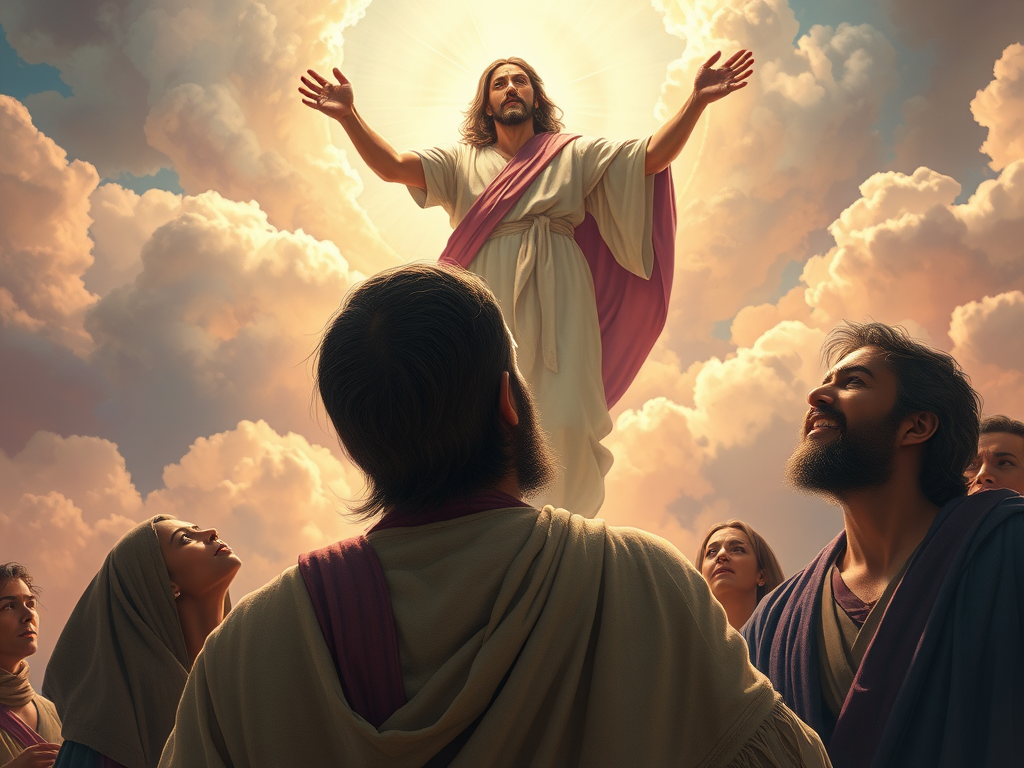
The Apostles See Jesus No More

In the opening verses of the NT Book of Acts, Luke gives us the account of Jesus’ ascension. This is not the only account we have of the ascension in the Bible. In Luke 24:50-52 there is a brief account.

But this passage contains some valuable information which the casual reader may easily miss.

Let’s look at the passage.

6.  So when the apostles were with Jesus, they kept asking him, “Lord, has the time come for you to free Israel and restore our kingdom?”  

6. they kept asking him. Their question shows they thought just as the Jews thought –in terms of a Davidic messiah and an earthly kingdom of Israel free of Roman rule. They were still focused on Israel and its future. It was not about the kingdom of Israel. It was about the Kingdom of Heaven. This would all soon change with the inauguration of the new covenant in Jesus’ blood.

7. He replied, “The Father alone has the authority to set those dates and times, and they are not for you to know.

 The Father alone sets dates, times. Jesus had already told the disciples that the timing of His coming was unknown (Mat 24:36). Only the Father determines the times and seasons.

8. But you will receive power when the Holy Spirit comes upon you. And you will be my witnesses, telling people about me everywhere—in Jerusalem, throughout Judea, in Samaria, and to the ends of the earth.”

But: Grk, G235 alla, contrariwise, emphatic—the disciples will have to think differently—to radically change their mind.

My witnesses: Very soon they will see him no longer because he is going to the Father, where they cannot come (see John 14:28-29). Instead, they are to receive power with the coming of the Holy Spirit and be his witnesses everywhere.  This would be a huge refocus. 

9. After saying this, he was taken up into a cloud while they were watching, and they could no longer see him. 

  • taken up into a cloud. Jesus was hidden from their eyes by a cloud as he went into Heaven. Clouds denote God’s glory. These ‘clouds’ appear to shut heaven, or the sky, from human view. He was hidden from their eyes by cloud. Just as He was hidden from their eyes as He went into Heaven, so when he comes He will be hidden to human eyes by the clouds of glory (Mat 24:30).

10. As they strained to see him rising into heaven, two white-robed men suddenly stood among them. 

they strained to see him. The cloud made it very difficult to see him, then impossible to see him.

two white-robed men. One of the many references to angels in the NT suddenly appearing (cf Luke 24:4 at the empty tomb). 

11. “Men of Galilee,” they said, “why are you standing here staring into heaven? Jesus has been taken from you into heaven, but someday he will return from heaven in the same way you saw him go!”

Jesus has been taken. Note the past tense ‘has been taken’

taken from you. They will see him no longer.

Men of Galilee. Here is aninteresting detail: they were addressed as ‘men of Galilee’. It is they who were addressed and not us today. Context is critically important for correct interpretation.

Jesus will someday return. The two ‘men’ declared Jesus will ‘someday’ return from heaven. The disciples already knew he would soon return (Matthew 10:23, 16:27-28, 24:30), but the hour or the day was unknown (Mat 24:36). This was a confirmation for them.

In the same way. The disciples could not see him because he was hidden by the cloud of glory. In the same way when he returns he will come in clouds of glory again hidden from human eyes in his then ascended form.  

This story shows us today that the coming return of Jesus was to occur within the lifespan of those present, these “men of Galilee”. So it rationally follows that return has already occurred!

This passage and the Matthew 24:30-34 passage, teach us the same thing: Jesus returned within the lifespan of the disciples!  

The coming of Jesus that we read in both Acts 1:6-11 and in the gospels (Matthew 10:23, 16:27-28, 24:30-34) cannot possibly be a “coming” that will occur in our future, for indeed, it has already occurred in the generation of the disciples.

Go figure!

Please prove me wrong.

The Resurrection of Believers

In the New Testament, there are passages that say the resurrection of believers will occur. This event will take place at the time of Christ’s second coming. These include 1 Corinthians 15 and 1 Thessalonians 4:16-17.

When He returns Jesus said He will gather those who have placed their faith in Him:.
And he will send his angels with a loud trumpet call, and they will gather his elect from the four winds, from one end of the heavens to the other.” Matthew 24:31.

Some passages mention our being with Jesus when we die. These assure us there will be a conscious state in fellowship with Jesus after death.

Thus in Luke 23:43 Jesus assured the repentant thief on the cross that they would be together in ‘Paradise’ that day. ‘Paradise’ translates the Greek word paradeisos Strongs G3847. That word was used for the Garden of Eden in the Greek Old Testament, the Septuagint.

In Luke 14:13-14 Jesus taught: when you give a reception, invite the poor, the crippled, the lame, the blind, and you will be blessed, since they do not have the means to repay you; for you will be repaid at the resurrection of the righteous.”

In Luke 16:22, we see what is referred to as ‘the bosom of Abraham’. This is deemed to the abode of the righteous dead awaiting the judgment day. It is a place of conscious awareness. Strongs G285—kolpos for bosom. It means to obtain the seat close to Abraham, i.e. to be partaker of the same blessedness as Abraham in paradise.

In Luke 20:35-36, Jesus said to the Sadducees:  those who are considered worthy to attain to that age and the resurrection from the dead, neither marry nor are given in marriage; for they cannot even die anymore, because they are like angels, and are sons of God, being sons of the resurrection.

In John 5:24-25. Jesus said Truly, truly, I say to you, he who hears my word, and believes Him who sent me, has eternal life, and does not come into judgment, but has passed out of death into life. Truly, truly, I say to you, an hour is coming and now is, when the dead will hear the voice of the Son of God, and those who hear will live.

In all the above spoken by Jesus, we note the certainty of resurrection of believers.

We also find that the Apostle Paul lived with the same certainty.

Paul wrote to the Corinthians: Now God has not only raised the Lord, but will also raise us up through His power. 1 Corinthians 6:14.

Certainty! No doubt.

And asking his readers that if from human motives he fought then what does it profit me? If the dead are not raised, let us eat and drink, for tomorrow we die. 1 Corinthians 15:31-32. Certainty.

Paul wrote to the Philippians about his certainty of his own resurrection. He expressed his preference to be absent from the body and to be at home with the Lord. Also see Philippians 1:20.

And in Philippians 3:10-11 this extraordinary hope: That . . . . . becoming like him in his death, that by any means possible I may attain the resurrection from the dead. That is, he had the expectation of his resurrection before his death. Thus he had the expectation of Jesus’ return before his death!

Matthew 12:32. And whoever speaks a word against the Son of Man will be forgiven, but whoever speaks against the Holy Spirit will not be forgiven, either in this age or in the age to come.

2 Peter 3:10-13. But the day of the Lord will come . . . . . . the coming of the day of God, because of which the heavens will be set on fire and dissolved, and the heavenly bodies will melt as they burn! But according to his promise we are waiting for new heavens and a new earth in which righteousness dwells.

Peter believed he and his contemporaries would experience new heavens and a new earth.

Isaiah 65:17-19. “For behold, I create new heavens and a new earth, and the former things shall not be remembered or come into mind. But be glad and rejoice forever in that which I create; for behold, I create Jerusalem to be a joy, and her people to be a gladness. I will rejoice in Jerusalem and be glad in my people; no more shall be heard in it the sound of weeping and the cry of distress.

Isaiah 26:19. Your dead will live; their corpses will rise. You who lie in the dust, awake and shout for joy, for your dew is as the dew of the dawn, and the earth will give birth to the departed spirits.

Interestingly, our resurrection has nothing to do with how “good” we are or our status with Jesus. Both those who are going to be with God and those who are going to be separated from God will be resurrected:

Daniel 12:2. And many of those who sleep in the dust of the ground will awake, these to everlasting life, but the others to disgrace and everlasting contempt.

Revelation 21:4  He will wipe away every tear from their eyes, and death shall be no more, neither shall there be mourning, nor crying, nor pain anymore, for the former things have passed away.”

JESUS’ LITTLE ONES!

The other night we were reading and sharing from Matthew 18. We discovered some startling things that Jesus said to his disciples when they asked him about who would be the greatest in his kingdom.  They did not expect his response, having in mind a realm like the world. He set a little child before them and said,

“Truly I say to you, unless you are converted and become like children, you will not enter the kingdom of heaven.”  (18:3)

There you have it boys.

To ask such a question showed up their need for conversion from attitudes of importance, self-interest and vanity—attitudes totally at odds with the nature of this kingdom. Such a radical change! How could they possibly become like this child? Everyone in their culture knew that little ones were not worth very much, they were totally dependent on their parents for how they thought, what they said and where there would go. Surely he can’t be serious! Surely there must be some hidden meaning here!

They braced for his further explanation, as by this stage they had to expect to be rattled once more (why keep on following this man –is he a man, or what?). . . . well they hardly knew what! Bombshell #25 or was it 27 or 28 coming?

“Whoever then humbles himself as this child, he is the greatest in the kingdom of heaven.”  (18:4)

The kingdom that Jesus constantly spoke about was a kingdom in which the desire to be important cannot exist at all. Humility is the essential key to entering this kingdom. This is utterly different to all other kingdoms, all of which are destined to fail while Jesus’ kingdom will endure forever, replacing all others. To enter it meant a total reversal of their values, to a dependency clearly demonstrated in the vulnerability and helplessness of a little child, a kind of death and new birth.

 “And whoever receives one such child in my name receives me, but whoever causes one of these little ones who believe in me to stumble, it would be better for him to have a heavy millstone hung around his neck, and to be drowned in the depth of the sea.”  18:1-6

Just who are these ‘little ones’?

They heard that if they desired to follow Jesus into his kingdom they must be prepared to undergo a radical change and be childlike. Then in this new status—like a little child—they find a new identity: by being ‘little ones’ they would become his agents bringing his message—so amazing that whenever they act for him, then whoever they meet who receives them, it is as if they are receiving Jesus! And conversely, when people come against them, the little ones, Jesus ones who believe, and place stumbling blocks in their path as they carry the kingdom message, the judgment on these would be severe.

“Woe to the world because of its stumbling blocks! For it is inevitable that stumbling blocks come; but woe to that man through whom the stumbling block comes!  (18:7)

Following Jesus they (and we) can expect many stumbling blocks—the original word is scandalizomai. Whose side do they want to be on? One will join the other side and betray him. Whose side do YOU who reads want to be on? The scandalized or the scandalizers?

This is another step in the training of his emissaries and though there be stumbling blocks to trip them up, impede their progress, Jesus wants them to know the out-of-this –world benefits, the glories, the exaltedness they could expect by humbling themselves under Jesus’ leadership, his easy yoke, his light burden.

And there’s more.

See that you do not despise one of these little ones, for I say to you that their angels in heaven continually see the face of My Father who is in heaven.” (10)

They must treat other little ones with honour because—think about it—they have angels in the heavenlies who never stop having face to face communication with Jesus’ Father. Wow. Imagine such guidance and protection.

Let’s say that again. You who have humbled yourselves under the Master’s command have the unfathomable privilege and continuous protection of God’s angelic hosts! So never despise any of the little ones!

There are the despisers and the despised. The scandalizers and the scandalized.

Then Jesus told a story of the 100 sheep and searches for the single straying one.  Then finding it, he rejoices over that single one more than over the others. He cares for every single one of us as if each were the only one!

So it is not the will of your Father who is in heaven that one of these little ones perish. (14)

Only believe! Believe you are a little one. Accept your new status as a little one. And watch!