
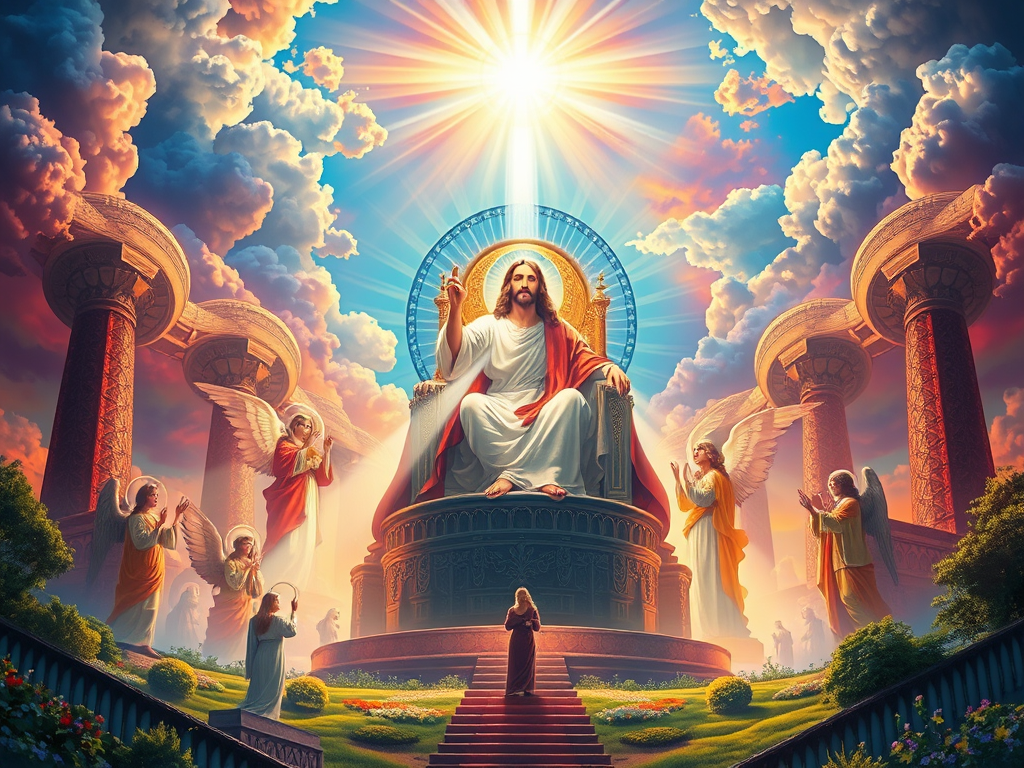
The phrase ‘the millennium reign of Christ on earth, is a form of eschatological speculation that contradicts the Church’s historical teachings on the nature of Christ’s reign. The apocalyptic passage of Revelation 20:4-6 is usually quoted by many teachers in support of this idea These writers include the popular online series ‘Got Questions?’.
These people claim that Jesus Christ will return and will establish Himself as king in Jerusalem, literally sitting on the throne of David. They quote Luke 1:32–33 as one of their proof texts:
He will be great and will be called the Son of the Most High. The Lord God will give him the throne of his father David, and he will reign over Jacob’s descendants forever; his kingdom will never end.”
No mention of Jerusalem here! He will reign not just on earth but in heaven for ever and ever. And we Christians today are enjoying His reign! For we are the true ‘Israel of God’ as Paul declared (Galatians 6:16).
Sending His disciples He said “all power is given unto me in heaven and earth.” (Mat 28:18)
Rev 1:5. John wrote: he is the ruler of all the kings of the world.
Rev 11:15 . . . . the seventh angel sounded . . . . saying, ‘The kingdoms of this world have become the kingdoms of our Lord and of His Christ, and He shall reign forever and ever'”.
Daniel 7:27: And the kingdom and the dominion and the greatness of the kingdoms under the whole heaven shall be given to the people of the saints of the Most High; his kingdom shall be an everlasting kingdom, and all dominions shall serve and obey him.
Revelation 20 just does not connect with the idea ‘while Christ reigns over the earth.’ It says ‘They reigned with Christ for a thousand years.’ Yes, but on earth? No. They have died and they have received their resurrection and will reign with him where He is, in heaven. (Revelation 20:4-6)
See John 14:3: And if I go and prepare a place for you, I will come back and take you to be with me that you also may be where I am.
Let’s interpret the obscure, apocalyptic passages of scripture by text that is perspicuous—a sound hermeneutic. Jesus has ascended and is reigning now and is seated at the right hand of God. To say He will take up residence in earthly Jerusalem is junk theology—believed by millions in a cult.
These teachers claim that unconditional covenants demand a literal, physical return of Christ to establish the kingdom.
These covenants don’t ‘demand’ a physical return. A physical return cannot be proved. Why do people think He would be optically ‘seen’ at His coming in judgment hidden in clouds of glory? He whom no one can see and live? Christian, we walk by faith, not by sight!
He told Pilate ‘My kingdom is not of this world.’
They claim that the Abrahamic covenant promises Israel a land, a posterity and ruler, and a spiritual blessing quoting Genesis 12:1–3. But what does it say:
“I will make you into a great nation, and I will bless you; I will make your name great, and you will be a blessing. I will bless those who bless you, and whoever curses you I will curse;
and all peoples on earth will be blessed through you.”
God covenanted with Abraham (you/thee, sing.) not Israel. All people will be blessed because of Abraham’s seed, which is Christ! See Galatians 3:7-9: Understand, then, that those who have faith are children of Abraham. Scripture foresaw that God would justify the Gentiles by faith, and announced the gospel in advance to Abraham: “All nations will be blessed through you.” So those who rely on faith are blessed along with Abraham, the man of faith.
They claim that the Palestinian covenant promised Israel a restoration to the land and occupation of the land (Deuteronomy 30:1–10).
True. But then the passage goes on, see verse 18: But if to other gods and [you] worship them, I declare to you this day that you will certainly be destroyed. You will not live long in the land you are crossing the Jordan to enter and possess. This day I call the heavens and the earth as witnesses against you that I have set before you life and death, blessings and curses. Now choose life, so that you and your children may live and that you may love the Lord your God, listen to his voice, and hold fast to him. For the Lord is your life, and he will give you many years in the land he swore to give to your fathers, Abraham, Isaac and Jacob.
They made the wrong choice, again and again and again. Consequently, they were certainly destroyed when Judea, Jerusalem and people were ravaged by the Roman armies in 66-70 AD after the real Jewish followers of Christ had escaped just as He instructed them. “When you see Jerusalem being surrounded by armies, you will know that its desolation is near. Then let those who are in Judea flee to the mountains, let those in the city get out, and let those in the country not enter the city. For this is the time of punishment in fulfilment of all that has been written. (Luke 21:20-22).
They also claim that the Davidic covenant promised Israel a king from David’s line who would rule forever—giving the nation rest from all their enemies (2 Samuel 7:10–13).
When your days are over and you rest with your ancestors, I will raise up your offspring to succeed you, your own flesh and blood, and I will establish his kingdom. He is the one who will build a house for my Name, and I will establish the throne of his kingdom forever.
That was fulfilled at the birth of Jesus as we saw above in Luke 1:32–33.
See also Daniel 7:13-14: “In my vision at night I looked, and there before me was one like a son of man, coming with the clouds of heaven. He approached the Ancient of Days and was led into his presence. He was given authority, glory and sovereign power; all nations and peoples of every language worshipped him. His dominion is an everlasting dominion that will not pass away, and his kingdom will never be destroyed.
In conclusion, let me say that this whole idea we have looked at here, rather briefly, is not reflected at all in the pages of the New Testament. Their proof texts are mostly from the Old Testament and the Book of Revelation.
All of this goes along with the obsession millions have about the nation-state of Israel founded not by God Almighty but by politicians and global elites like the wealthy Ashkenazi Jewish banking family Rothschilds.
We are the people of God as Peter wrote to congregations of Jews and Gentiles (1 Peter 2:9).
Repeating, God covenanted with Abraham (Gen 12:1-3):
“I will make you into a great nation, and I will bless you; I will make your name great, and you will be a blessing. I will bless those who bless you, and whoever curses you I will curse; and all peoples on earth will be blessed through you.”
Today, we believers in Jesus are that ‘great nation’, not the Israeli state. We are blessed and will be a blessing, and all peoples on earth are being blessed by us!
Let’s do it!

 Ian Thomson