Tag Archives: religion

The True People of God

Here’s my exegesis of Matthew 21:43, considering its context, language and significance:

“Therefore I tell you, the kingdom of God will be taken away from you and given to a people producing its fruits.”


This verse is the concluding declaration of Jesus’ Parable of the Tenants (vv. 33-41), spoken directly to the chief priests and Pharisees (v. 45).

In the parable, a landowner (God) leases his vineyard (Israel; Isa. 5:1-7) to tenants (religious leaders). They reject/kill the owner’s servants (prophets) and finally his son (Jesus). Judgment falls on the tenants.

The leaders themselves pronounce judgment (v. 41): “He will put those wretches to a miserable death and let out the vineyard to other tenants”.

Jesus confirms their verdict (v. 43) and connects it to Psalm 118:22-23 (vv. 42, 44) about the rejected stone becoming the cornerstone.

Key Terms & Meaning:


“Therefore” (Greek: Dia touto): Links the verse directly to the leaders’ self-condemnation in the parable.

“Kingdom of God”: Refers to God’s reign/authority entrusted to Israel as His covenant people (Ex. 19:5-6; Dan. 2:44).

  • “Taken away from you”: “You” = Israel’s current leadership. They failed as stewards by rejecting God’s messengers and his Son.
  • “Given to a people” (Greek: ethnei): Ethnos typically means “nation” or “people”.
    • This people refers to a new covenant community (Jew + Gentile) under Christ (1 Pet. 2:9-10). This includes faithful Jews who accept Jesus (e.g., apostles) and Gentiles who are ‘grafted in’ to use Paul’s term (Rom. 11:17-24).

“Producing its fruits”: These include obedience, repentance, justice, and faithfulness (Matt. 3:8; 7:16-20). This contrasts with the leaders’ spiritual barrenness (Matt. 23:13-33).

 Theological Significance:

Divine Judgment: God’s kingdom is not irrevocably tied to ethnic Israel or its corrupt leaders. Stewardship requires faithfulness.


Inclusive Redefinition: The kingdom is transferred to a new people of God (the Church) centered on Christ (Eph. 2:11-22). This fulfils Abrahamic promises (Gal. 3:29).

Continuity & Fulfillment: Jesus is the “stone” (vv. 42, 44) establishing God’s kingdom (Dan. 2:44-45). The Church inherits Israel’s spiritual privileges (Rom. 9:6-8; Gal. 6:16).

Warning to All: Leadership in God’s kingdom demands fruitfulness, not just privilege (John 15:1-6).


Application:


To the Original Audience: A direct indictment of Israel’s leaders, warning that rejecting Jesus forfeits their role in God’s plan. Unbelieving Israel forfeits its chosen people status. Plainly, according to Jesus.

To the new People of God: This is a call to faithful stewardship, both Jew and Gentile. Privilege implies responsibility.

To Individuals: Entrance into God’s kingdom requires receiving Christ (John 1:12) and bearing spiritual fruit.

Connection to Jesus:

This verse underscores Jesus’ authority to redefine the people of God around Himself. His impending death/resurrection (which is implied in the parable) will inaugurate the new covenant community which replaces or replenishes Israel.

In Summary

Matthew 21:43 declares a monumental shift—the kingdom stewardship passes from unfaithful leaders to a new, multi-ethnic people under Christ, marked by responsive faith and spiritual fruitfulness. This is both a warning and a promise of God’s unfolding redemptive plan.

Jesus’ authority to redefine the true people of God around Himself is emphatically expressed and cannot be denied.

This redemptive plan falsifies the teaching of Dispensationalism. The nation state of Israel is not Paul’s “Israel of God.” (Gal 6:16)

Prove me wrong!

Rapture? Three Greek Words

Subscribe to continue reading

Subscribe to get access to the rest of this post and other subscriber-only content.

How to Conquer a Death Cult

by Andrew Torba

There are moments in history when the veil is lifted, and the true nature of an ideology is laid bare for all to see. The aftermath of the cowardly assassination of Charlie Kirk was one of those moments. While patriots across America mourned the loss of a bold voice for freedom, truth, and the future of our nation, the Left erupted in celebration.

They laughed. They cheered. They shared memes. They hailed the murderer as a hero. They desecrated the memory of a man gunned down for the simple act of speaking truth.

This is not an anomaly. This is not the work of a few bad apples. This is the logical endpoint of liberalism: a death cult that worships at the altar of destruction.

At its core, this ideology venerates death. It champions the right to end innocent life in the womb, rebranding the slaughter of the unborn as “healthcare” and a sacred right. It encourages the chemical and surgical mutilation of healthy young bodies, a grotesque parody of medicine that severs the individual from their own biological reality. It pushes policies that dissolve the fundamental bonds of family and community, leaving isolated, atomized individuals adrift in a meaningless sea of consumer choices and state dependency.

Now, they celebrate political assassinations.

This is who they are. This is what they believe in. There is no life in their ideology only decay, degradation, and death. They cannot create, so they destroy. They cannot build, so they tear down. They cannot defend truth, so they silence those who speak it.

Charlie Kirk was a threat to them not because he was violent, not because he preached hatred, but because he represented something they despise: life, vitality, courage, and a future for our people. He stood for the America they are trying to erase. In their twisted world, the murder of a young man with a family, friends, and a mission is cause for joy. In their moral vacuum, the blood of the innocent is just another tool in their war against God, nature, and order.

We see you. We see your hatred. We see your emptiness. We see the hollow, lifeless eyes of a movement that has nothing left to offer but destruction, and we will not be silenced. We will mourn Charlie. We will honor his legacy. We will continue his work. And we will remember this moment, the moment the death cult showed its true face to the world.

They think this will frighten us into submission. They are wrong. It only strengthens our resolve.

For we are the builders. We are the defenders. We are the bearers of life, faith, and hope. We will never stop fighting for the future they are so desperate to destroy.

The modern liberal worldview is a hollowed-out edifice built upon a foundation of nihilism and resentment. It is not merely misguided; it is, in its essence, a metaphysical rebellion against creation itself. Its pillars are not principles of life, order, or continuity, but glorifications of decay, fragmentation, and ultimate negation.

This is not an accident. A culture that severs itself from its spiritual and biological roots—from faith, from heritage, from the natural order of the family—has nothing left to affirm. Having rejected the sacred, it can only profane. Having rejected creation, it can only dismantle.

This is the death cult. It masks its emptiness with the language of “compassion” and “progress,” but its fruits are everywhere: fatherless homes, soul-crushing addiction, mental illness on an epidemic scale, and a culture that produces young people so deracinated and hopeless that they cheer for murder.

They offer no future, only an endless, sterile present of managed decline. They cannot create beauty, so they deface monuments. They cannot produce harmony, so they amplify chaos. They cannot foster life, so they defend every manifestation of death.

Our response cannot be mere political opposition. It must be a total and profound rejection of their entire worldview. We must be the unequivocal champions of life. We must build large, faithful families. We must create beautiful and lasting things. We must reaffirm our connection to God, to our people, and to the land. We must be so generative, so life-affirming, and so filled with purpose that their culture of death simply withers in the shadow of our vitality.

They celebrate the darkness because they have forgotten what the light looks like. It is our duty to shine it so brightly that they are forced to remember, or to look away.

The spirit of the age does not knock politely at the Church’s door; it slithers in directly from the pulpit. The same death cult that celebrates murder in the streets and glorifies mutilation in the classroom has found a comfortable home within the compromised walls of modern Christianity. It has exchanged the robust, world-conquering faith of our fathers for a weak, effeminate, and apologetic social club, a chaplaincy to the very regime that seeks our destruction.

This infiltration is a betrayal of our entire history. Look to the men who built Christendom. They were not managers of decline. They were not anxious pleasers of the world. They were conquerors. They were kings, knights, saints, and martyrs who carved civilization out of wilderness and darkness with the sword of truth and the shield of faith. They understood that the Gospel was not a suggestion; it was a mandate to reclaim every inch of creation for Christ the King.

This was a masculine Christianity. It spoke of order, justice, duty, and victory. It built cathedrals that scraped the heavens, universities that pursued divine wisdom, and legal systems based on eternal law. It tamed empires and baptized cultures. It did not ask for permission from the world; it commanded the world to bend the knee.

Now, look at what we have been given. A Church that has traded its crown for a begging bowl. A faith that preaches “tolerance” instead of truth, “dialogue” instead of discipleship, and “inclusion” instead of repentance. It busies itself with ESG scores, climate change rituals, and draping rainbow flags over the cross in a pathetic attempt to gain the approval of a world that will always despise it.

This weakness is a theological and spiritual sickness. It is a failure of nerve and a failure of faith. It is the direct result of a Church that has abandoned its masculine, commanding nature and instead embraced the world’s feminine, receptive values of passivity, feel-good therapy, and endless compromise.

We see it in the pulpit, where the fire of prophecy has been replaced by the damp squib of motivational speaking. We see it in the seminary, where future shepherds are taught to be bureaucrats rather than warriors. We see it in the pews, where men are given no mission, no challenge, and no standard to strive for and so they leave.

This must end. The roots of this parasitic ideology must be ripped out, burned, and salt poured into the earth where they grew.

We must return, with unapologetic fervor, to the Christianity that built the West.

We must preach a God who is a Father, a King, and a Judge not a vague, affirming force. We must call men to be saints, not therapists; to be leaders of households and nations, not passive observers. We must reclaim the arts, the laws, the sciences, and the governance of our people as our rightful domain, given to us by God to steward for His glory.

This means cleansing our institutions. It means defunding and disempowering every committee, diocese, and seminary that trades in this death-cult poison. It means supporting only those bishops and pastors who act like fathers and generals, not like corporate spokesmen. It means building parallel networks of education, media, and community that operate wholly outside the corrupt systems of the world.

We are not called to be a quaint subculture. We are called to be a conquering army, baptizing the nations for the glory of God. The same faith that once turned the Roman world upside down is still there, waiting beneath the layers of weakness and compromise. The remnant remains intact. It is time to rediscover it. It is time to stop managing our retreat and start planning our advance.

The world offers death. We must offer life, fierce, abundant, and eternal. We must be so strong in faith, so clear in truth, and so bold in action that the world has no choice but to once again reckon with the power of the God we serve.

Do not let the fire in your belly die. The righteous anger, the profound grief, the clarity of purpose that Charlie Kirk’s martyrdom ignited within you. This is not a fleeting emotion to be forgotten with the next news cycle. This is a sacred fuel. Guard it. Nurture it. Feed it with prayer, with action, and with an unbreakable resolve to ensure his death was not in vain.

Let this flame forge you into a sharper tool for this battle, a more formidable wall against the advancing darkness. The world wants you to get tired, to get comfortable, to forget. Do not give them that satisfaction. Honor Charlie’s memory by making this fire the eternal pilot light of your spirit, guiding your every thought, word, and deed until the work is done and our people are once again free, sovereign, and thriving under God.

Andrew Torba
CEO, Gab AI Inc
Christ is King

Published in Bold Christian Writing

The AD 66 Angelic Army of Fire in the Sky

I have written many times about how mistaken we are if we thought Christians would literally see the bodily return of Christ. This would be impossible.
 In my last post I wrote about the error which the famed scholar C S Lewis made. Lewis blatantly said Jesus was mistaken! He said Jesus failed to come back in the End times as he said he would. (See his book “The World’s Last Night”).
 Many others, liberal scholars, atheists and Islamic writers have assumed that since Jesus was never seen by human eyes optically, that he never appeared.

Interestingly, Lewis never resorted to twisting Jesus’ words like so many modern teachers and scholars do in claiming that Jesus meant that “this generation” meant some far-in-the-future generation! 

              Shame on those manipulators of the sacred scriptures!

But why should any human eyes see the Lord who after his ascension and glorification dwells in light at the Father’s right hand? Whose face was like the sun in all its brilliance? Whose eyes were like flames of fire? (Rev 1:14-16).
It is a huge mistake to think you could see Jesus’ coming in His bodily form with human eyes. Paul wrote he “dwells in unapproachable light, whom no one has seen or can see” (1 Timothy 6:16).

Jesus warned the disciples that they could be deceived by reports of sightings of his appearance at his coming (Mat 24:23-26; Luke 21:8).

The apostles expected Jesus to return within their lifetimes. Just how they would experience his coming they were not told. There is one exception to this in Paul’s Letter to the Thessalonians:

He told them how Jesus would pay them back for their suffering by the apostate Jews. God will provide rest for you who are being persecuted and also for us when the Lord Jesus appears from heaven. He will come with his mighty angels, in flaming fire, bringing judgment on those who don’t know God and on those who refuse to obey the Good News of our Lord Jesus. (2 Thes 1:7-8)

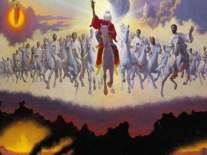
The Second Coming is also described in In the Book of Revelation. There we read a vision. Jesus rides a white horse leading an army of angels on horseback on the clouds:

 Then I saw heaven opened, and a white horse was standing there. Its rider was named Faithful and True, for he judges fairly and wages a righteous war. His eyes were like flames of fire, and on his head were many crowns. A name was written on him that no one understood except himself. He wore a robe dipped in blood, and his title was the Word of God. The armies of heaven, dressed in the finest of pure white linen, followed him on white horses. From his mouth came a sharp sword to strike down the nations. He will rule them with an iron rod. He will release the fierce wrath of God, the Almighty, like juice flowing from a winepress.  (Revelation 19:11-15)

We read also that Jesus told the disciples that when they would see Jerusalem surrounded by armies they must all flee from Jerusalem and Judea. “And when you see Jerusalem surrounded by armies, then you will know that the time of its destruction has arrived. Then those in Judea must flee to the hills. Those in Jerusalem must get out, and those out in the country should not return to the city. For those will be days of God’s vengeance, and the prophetic words of the Scriptures will be fulfilled.” (Luke 21:20-22)

Now this statement of Jesus has puzzled many people. How can it be that when Jerusalem is completely surrounded, encircled with armies, then the people of God are told to flee the whole area of Judea and Jerusalem? Are they to surrender to the Roman armies? There would no way to escape through the Roman lines and walls the Romans had put up around the city.

But this is not what Jesus meant in his warning. What is the answer?

This prophecy of Jesus was fulfilled exactly in the period just before the war that destroyed Jerusalem. This was from A.D. 67 to 70.  How do we know?

We know by reading the eyewitness account of the Jewish historian Josephus. He was the historian who saw or reported all that occurred in Judea within that three-and-a-half year period. This included what which took place in the skies above Jerusalem. Such a sight could not be identified as having its origin on earth.

This was clearly a “sign” from heaven. This was a fulfilment of what Jesus said would occur that is recorded in Luke 21:20. Josephus said this happened just before the war with Romans began:

“On the twenty-first of the month Artemisium [the last day of the 2nd Passover season in A.D. 66], there appeared a miraculous phenomenon, passing belief. Indeed, what I am about to relate would, I imagine, have been deemed a fable, were it not for the narratives of eyewitnesses and for the subsequent calamities which deserved to be so signalized. For before sunset throughout all parts of the country, chariots were seen in the air and armed battalions hurtling through the clouds and encompassing the cities.” (Wars, VI. 5. 3 or Loeb VI. 298).

The Roman historian Tacitus (c. AD 56-120) records the same event in his Histories:

“Prodigies had occurred, but their expiation by the offering of victims or solemn vows is held to be unlawful by a nation which is the slave of superstition and the enemy of true beliefs. In the sky appeared a vision of armies in conflict, of glittering armor. A sudden lightning flash from the clouds lit up the Temple. The doors of the holy place abruptly opened, a superhuman voice was heard to declare that the gods were leaving it, and in the same instant came the rushing tumult of their departure. Few people placed a sinister interpretation upon this. The majority were convinced that the ancient scriptures of their priests alluded to the present as the very time when the Orient would triumph and from Judaea would go forth men destined to rule the world. (Histories”, Book 5, v. 13)

Also we see what Eusebius of Caesarea (A.D. 263-339) says in his Ecclesiastical History —

“For before the setting of the sun chariots and armed troops were seen throughout the whole region in mid-air, wheeling through the clouds and encircling the cities.” (Book 3, Ch. 8)

The parallels between these three accounts and 2 Thessalonians 1:7-8 are striking. In these three, Jesus is never identified as being at the head of this angelic army in the clouds. Yet he must have been, as we saw in Revelation 19.

So this miraculous angelic army was seen in the sky in A.D. 66 by thousands across the land of Judea.  It was made known by Roman historians, unbelievers. Thus Paul’s prophecy in his second letter to the Thessalonians 1:7-8 was fulfilled!

Throughout his earthly ministry, Jesus predicted that he would come on the clouds obscured among the presence of the heavenly host. And this coming within the lifetimes of those present during his ministry. (Matthew 10:23, 16:27-28, 24:34)

What will you with this amazing information?

Prove me wrong!

The End: What You Cannot Deny

This article discusses what is meant by the biblical term ‘the end’ and in its Jewish context  We will also discuss various beliefs about when, how and what the coming of the end means for believers. Many mistakes and assumptions made by modern Christians will be exposed and hopefully corrected.

We find the phrase ‘the end’ in many eschatological contexts. But, just what is it the end of?

This is the end of an age, a long period of time. It is the end of the Mosaic age, Judaism. It’s the end of the Jewish sacrificial system, of the whole of the Jerusalem Temple and priesthood mediation. 

It is a mistake to think that the end of the age means the end of the world or the end of history. For the Jews it meant the end of the ‘current’ Jewish age, the beginning of the new age of the Messiah.

Jesus charged the disciples with the Great Commission, promising He would be with them “until the end of the age”. Some people think Jesus meant that before the end comes that the gospel must be preached to all nations. The degree of completion of this task is seen by many as a significant indicator of the approaching end times. That is also a mistake.

One of the most notable references to the End is found in Matthew 24. Verse 14 says:  this gospel of the kingdom will be preached in all the world as a testimony to all nations, and then the end will come. 

This convinces many readers that the end occurs after the gospel has been preached to all nations.

But in fact, the single Greek word Jesus used for the phrase ‘all the world’ meant something else to the disciples. It meant the Roman world or the known civilised world.

Jesus did not say ‘all would hear about the kingdom’. He said that the kingdom will be preached in all the inhabited earth. This ‘world’ was all reached within the lifetime of the apostle Paul. See the evidence at for this in Romans 10:18, 15: 10, 16:18, Colossians 1:6, 1 Thessalonians 1:8). 

That, my friends, is sensational. The End has come already. That is undeniable.

Another reference to the End is found in Paul’s 1 Corinthians 15:22-25 “For as in Adam all die, so also in Christ all will be made alive. But each in his own order: Christ the first fruits, after that those who are Christ’s at His comingThen the end will come, when He hands over the kingdom to God the Father after He has destroyed all dominion, authority, and power.  For He must reign until He has put all His enemies under His feet.  The last enemy that will be abolished is death”.

 This ‘End’ passage is centred around Paul’s teaching on the resurrection of the dead. It shows the end comes after Jesus has completed his mission and handed over the kingdom to God the Father.

Jesus was the ‘first fruits’—He was the first to rise from the dead. Others follow! Jesus has certainty completed His mission and returned to the Father long ago.

1 Corinthians 15:51-52 accurately foretells that after the last trumpet has sounded, believers are consequently and quickly raised to new life after their physical death! This continues to the present day.

It is undeniable that Christians celebrate this wonderful fact at every funeral of our fellow believers!

The sound of the trumpet is a powerful biblical image associated with significant divine announcements, such as the giving of the Law at Sinai, and the call to assemble the Israelites. 

Here the “last trumpet” is the call for people of God to gather to meet the Lord also described in Matthew 24:31 and 1 Thessalonians 4:17. What could be a more significant divine announcement?

Revelation describes various events to unfold during the last days: Revelation 1:1-3; 22:6-7, 12,20.

Sure, Jesus said that no one knows the exact day or hour of His return (Matthew 24:36). But He did not say ‘years, centuries or millennia’. And He added it would be in the lifetime of many of the people He spoke with face to face. (Matthew 10:23, 16:27-28, 24:34). See, that is undeniable.

Then The End Will Come.

So when do you expect “the end’ to occur? And how do you expect Him to appear?

There is an error which the famed scholar C S Lewis made. Lewis blatantly said Jesus was mistaken! He said Jesus failed to come back in the End times as he said he would. (See his book “The World’s Last Night”). That is also the mistaken view of many liberal scholars, atheists and Islamic writers. They have assumed that since Jesus was never seen by human eyes optically, that He never appeared.

But why should any human eyes see the Lord who after His ascension and glorification dwells in unapproachable light at the Father’s right hand? No one in human flesh can see Him and live.

The first Christians expected Jesus to return within their lifetimes. Exactly how they would experience His coming they were not told. So we must be cautious in what to expect, not assuming things.

The apostles wrote 100 times in the NT letters of Jesus’ imminent coming. It is undeniable they could possibly all been mistaken.  See Romans 13:11-13; 16:20; 1 Corinthians 1:7; 4:5; 10:6; Philippians 1:6; 3:11; 1 Thessalonians 1:10-10  for undeniable evidence.  The apostles referred often to the “last days,” urging believers to be ready:  See 1 Peter 1:201 Corinthians 10:11Hebrews 1:2).

Many theologians in their blindness cannot see. So they adapted teachings to explain the apparent delay, making false assumptions. So they claim that Jesus did not mean in His current generation It must be some future generation—a nonsense assumption. Please see my article on this issue here.

Others offer the absurd explanation that the word ‘generation’ meant ‘race’ i.e., the Jewish race. We must stick to the plain words of Jesus. He consistently attacked “this evil generation” the Jews of His own generation.

It is another mistake to believe the End will be a worldwide event seen optically, quoting Matthew 24:23–30 literally. But Biblical prophesies of the collapsing of cosmic entities were a common motif in judgment prophecy, e.g. Isa 13:10, 19:1,24:18-20, 34;8-15, Ezek 32:7–8; Joel 2:28; Nah 1:3Pss 18, 104:3). This would be understood by informed Jews familiar with the prophets and as Jesus taught His disciples.

Jesus said His return will come with speed, brightness, and power, as lightning! Jesus is not seen in the sky but ‘seen’ seated in the heavenly places at the Father’s side! Stephen said to the Sanhedrin, at his trial, “I see the heavens opened, and the Son of man standing at the right hand of God” (Acts 7:56).

It is a huge mistake to think you could see Jesus’ second coming optically.  He sits at the right hand of power. He “dwells in unapproachable light, whom no one has seen or can see” (1 Timothy 6:16).

The scriptures are plain. How clearer can we get?  It’s time for your denial to end, the brainwashing, the cognitive dissonance to be recognised and truth to prevail.

Truth is demanded by the Lord from us all. Jesus is the truth. He seeks those who want to worship God in spirit and in truth, not those who seek fantasies, like some imagined rapture.

Instead, as He said to the disciples before they killed Him: I do not ask {Father} to take them out of the world, but to keep them from the evil one. They are not of the world, even as I am not of the world. Sanctify them in the truth; Your word is truth.  As You sent Me into the world, I also have sent them into the world.  John 17: 15-18

More on the Great Tribulation

This article follows one I posted some years ago, which you can read here.

The Great Tribulation was one of the several events that Jesus said would take place before He returned. He said these events would all take place before His (‘the disciples’) generation would pass away. It is a no-brainer and incontrovertible fact that generation has long past away! Please remember, Jesus was talking to the people in front of him not people like us thousands of years ahead in time.

The Great Tribulation (TGT) was said by Jesus to be “cut short” so that the believers could flee Judea.

Jesus gave the disciples two signs when they must flee.

In Matthew, Jesus told them when they see the prophesied Abomination of Desolation (Matthew 24:15) standing in the Temple, the believers must flee Jerusalem.

Luke’s gospel says when they see Jerusalem surrounded by armies (Luke 21:20), the believers must get away.

So in Matthew .we read:

16. . . . .   when you see the abomination of desolation . . . . . then those who are in Judea must flee to the mountains. 17 Whoever is on the housetop must not go down to get the things out that are in his house. 18 Whoever is in the field must not turn back to get his cloak. .’ . . . .   21 For then there will be a great tribulation, such as has not occurred since the beginning of the world until now, nor ever will. 22 Unless those days had been cut short, no life would have been saved; but for the sake of the elect those days will be cut short. 

Or in Luke 21:20-22 we read:

20 when you see Jerusalem surrounded by armies, then you will know that the time of its destruction has arrived. 21 Then those in Judea must flee to the hills. Those in Jerusalem must get out, and those out in the country should not return to the city.  22 because these are days of vengeance, so that all things which are written will be fulfilled. 

God’s wrath would not be poured out until the saints had escaped. Thus many Jewish lives would be saved. Luke tells us because these are days of wrath and vengeance so that all things prophesied and written become fulfilled.

Now about the “tribulations of the saints”?

This terrible tribulation event was defined in the Olivet Discourse (Matthew 24:21) as a divine wrath-outpouring on the unbelieving Jews. This is sometimes confused with the fierce persecution of the real believers by the apostate Jews. (Matthew 24:16).

The tribulations or suffering of the saints described in many NT passages was persecution from Jews. This was not Neronic persecution. It was not the Great Tribulation (TGT). We see this persecution clearly in the Gospels, the Book of Acts and letters to the Thessalonians, Galatians and Hebrews, among others.

We note that Jesus warned the disciples in the Olivet Discourse that ‘a time of great’ persecution would come from Jews and synagogues and even family members.

Luke records Jesus’ words: But before all this occurs, there will be a time of great persecution. You will be dragged into synagogues and prisons, and you will stand trial before kings and governors (Luke 21:12).

Finally, we find the term ‘great tribulation’ also mentioned in Revelation 7 saying  ’. . . those who come out, or are coming out of great tribulation (7:14).

4 And I heard the number of those who were sealed, one hundred and forty-four thousand sealed from every tribe of the sons of Israel . . . .  9 After these things I looked, and behold, a great multitude which no one could count, from every nation and all tribes and peoples and tongues, standing before the throne and before the Lamb, clothed in white robes, and palm branches were in their hands; 10 and they cry out with a loud voice, saying, “Salvation to our God who sits on the throne, and to the Lamb.” 11 And all the angels were standing around the throne and around the elders and the four living creatures; and they fell on their faces before the throne and worshiped God, 12 saying, “Amen, blessing and glory and wisdom and thanksgiving and honor and power and might, be to our God forever and ever. Amen.” 13 Then one of the elders answered, saying to me, “These who are clothed in the white robes, who are they, and where have they come from?” 14 I said to him, “My lord, you know.” And he said to me, “These are the ones who come out of great tribulation, and they have washed their robes and made them white in the blood of the Lamb. 

In this Revelation 7 passage the definite article is not in the original text.  Also, the Greek participle (erchomenoi) is in the present continuous tense. That indicates those saints were or are coming out of some great suffering on earth. They suffered for Jesus’ sake on His mission, just as predicted by Jesus and explained above—not the Great Tribulation.

We can say assuredly that Jesus had provided the way of escape for believers (as above) and so the Revelation 7 passage is not about believers suffering the fate of the apostate Jews who had rejected their Christ. How could it possibly be that!

Also in the Revelation 7:9 passage, John saw they were a vast crowd, too great to count, from every nation and tribe and people and language. That must include Gentiles! This forces us to understand this great suffering was not “the great tribulation” of Matthew 24.

The angel’s phrase ‘are coming out’ must mean they are escaping the Great Tribulation—they are coming out of Jerusalem and Judea by obeying Jesus’ words.

Conclusion

Let us continue today to be on Jesus’ mission. Let us go on, standing before His throne and before the Lamb, clothed in ‘white robes,’ of righteouness joining the countless number and the angels, who are crying outout with a loud voice, saying, “Salvation to our God who sits on the throne, and to the Lamb” everywhere and to everyone.

The Resurrection of Believers

In the New Testament, there are passages that say the resurrection of believers will occur. This event will take place at the time of Christ’s second coming. These include 1 Corinthians 15 and 1 Thessalonians 4:16-17.

When He returns Jesus said He will gather those who have placed their faith in Him:.
And he will send his angels with a loud trumpet call, and they will gather his elect from the four winds, from one end of the heavens to the other.” Matthew 24:31.

Some passages mention our being with Jesus when we die. These assure us there will be a conscious state in fellowship with Jesus after death.

Thus in Luke 23:43 Jesus assured the repentant thief on the cross that they would be together in ‘Paradise’ that day. ‘Paradise’ translates the Greek word paradeisos Strongs G3847. That word was used for the Garden of Eden in the Greek Old Testament, the Septuagint.

In Luke 14:13-14 Jesus taught: when you give a reception, invite the poor, the crippled, the lame, the blind, and you will be blessed, since they do not have the means to repay you; for you will be repaid at the resurrection of the righteous.”

In Luke 16:22, we see what is referred to as ‘the bosom of Abraham’. This is deemed to the abode of the righteous dead awaiting the judgment day. It is a place of conscious awareness. Strongs G285—kolpos for bosom. It means to obtain the seat close to Abraham, i.e. to be partaker of the same blessedness as Abraham in paradise.

In Luke 20:35-36, Jesus said to the Sadducees:  those who are considered worthy to attain to that age and the resurrection from the dead, neither marry nor are given in marriage; for they cannot even die anymore, because they are like angels, and are sons of God, being sons of the resurrection.

In John 5:24-25. Jesus said Truly, truly, I say to you, he who hears my word, and believes Him who sent me, has eternal life, and does not come into judgment, but has passed out of death into life. Truly, truly, I say to you, an hour is coming and now is, when the dead will hear the voice of the Son of God, and those who hear will live.

In all the above spoken by Jesus, we note the certainty of resurrection of believers.

We also find that the Apostle Paul lived with the same certainty.

Paul wrote to the Corinthians: Now God has not only raised the Lord, but will also raise us up through His power. 1 Corinthians 6:14.

Certainty! No doubt.

And asking his readers that if from human motives he fought then what does it profit me? If the dead are not raised, let us eat and drink, for tomorrow we die. 1 Corinthians 15:31-32. Certainty.

Paul wrote to the Philippians about his certainty of his own resurrection. He expressed his preference to be absent from the body and to be at home with the Lord. Also see Philippians 1:20.

And in Philippians 3:10-11 this extraordinary hope: That . . . . . becoming like him in his death, that by any means possible I may attain the resurrection from the dead. That is, he had the expectation of his resurrection before his death. Thus he had the expectation of Jesus’ return before his death!

Matthew 12:32. And whoever speaks a word against the Son of Man will be forgiven, but whoever speaks against the Holy Spirit will not be forgiven, either in this age or in the age to come.

2 Peter 3:10-13. But the day of the Lord will come . . . . . . the coming of the day of God, because of which the heavens will be set on fire and dissolved, and the heavenly bodies will melt as they burn! But according to his promise we are waiting for new heavens and a new earth in which righteousness dwells.

Peter believed he and his contemporaries would experience new heavens and a new earth.

Isaiah 65:17-19. “For behold, I create new heavens and a new earth, and the former things shall not be remembered or come into mind. But be glad and rejoice forever in that which I create; for behold, I create Jerusalem to be a joy, and her people to be a gladness. I will rejoice in Jerusalem and be glad in my people; no more shall be heard in it the sound of weeping and the cry of distress.

Isaiah 26:19. Your dead will live; their corpses will rise. You who lie in the dust, awake and shout for joy, for your dew is as the dew of the dawn, and the earth will give birth to the departed spirits.

Interestingly, our resurrection has nothing to do with how “good” we are or our status with Jesus. Both those who are going to be with God and those who are going to be separated from God will be resurrected:

Daniel 12:2. And many of those who sleep in the dust of the ground will awake, these to everlasting life, but the others to disgrace and everlasting contempt.

Revelation 21:4  He will wipe away every tear from their eyes, and death shall be no more, neither shall there be mourning, nor crying, nor pain anymore, for the former things have passed away.”

The Age to Come

As Jesus was leaving the Temple grounds, his disciples came along and wanted to take him on a tour of the various Temple buildings. 2 But he told them, “All these buildings will be knocked down, with not one stone left on top of another!” 3 “When will this happen?” the disciples asked him later, as he sat on the slopes of the Mount of Olives. “What events will signal your return and the end of the age?” 4 Jesus told them, “Don’t let anyone fool you. 5 For many will come claiming to be the Messiah and will lead many astray. 6 When you hear of wars beginning, this does not signal my return; these must come, but the end is not yet. Matthew 24:1-6

The Hebrew Bible and Jewish tradition referred to a future era of divine fulfilment, the Messianic Age. This period was envisioned as an age of universal peace, harmony, and the reign of the Messiah, where evil will be eradicated, and the knowledge of the Creator will be widespread.

That’s why Jesus and the disciples along with the Jews expected a future era which was referred to as ‘the age to come’, contrasting with their current age.

In Christian tradition, the “age to come” is similarly associated with the return of Jesus Christ and the establishment of the Kingdom of God.  

For Jews, the idea of the Messianic Age is deeply rooted in the Hebrew Bible, particularly in the books of the prophets. Isaiah speaks of a time when “nation will not lift sword against nation” and “they will no longer study warfare. Isaiah 2 speaks of a time when the Mount of the Lord’s house will be established as the highest of the mountains, and all nations will stream to it, seeking peace and learning the ways of the Lord.

Isaiah 11 describes the Messianic Age as a time when a shoot will come forth from the stump of Jesse (David’s father), and a branch from his roots will bear fruit.

This figure, the Messiah, will be filled with the Spirit of the Lord, bringing wisdom, understanding, counsel, might, knowledge, and the fear of the Lord.

The Messianic Age is also described in Isaiah 32, where the Spirit of the Lord will be poured out on the people, leading to a time of peace, security, and prosperity. The passage emphasizes that the earth will be filled with the knowledge of the Lord, as the waters cover the sea.

In addition, Isaiah 42 highlights the Messiah’s role in bringing justice to the nations. He will not falter or be discouraged until he establishes justice on earth, and the nations will look to him for guidance and hope.

Isaiah 65:17-19. “For behold, I create new heavens and a new earth, and the former things shall not be remembered or come into mind. But be glad and rejoice forever in that which I create; for behold, I create Jerusalem to be a joy, and her people to be a gladness. I will rejoice in Jerusalem and be glad in my people; no more shall be heard in it the sound of weeping and the cry of distress.

These Old Testament passages collectively paint a picture of the Messianic Age as a time of peace, justice, and the presence of God’s Spirit, where the Messiah will reign and bring about a new era of harmony and righteousness.

Now consider these passages from the New Testament:

Now consider these passages from the New Testament:

Matthew 12:32. And whoever speaks a word against the Son of Man will be forgiven, but whoever speaks against the Holy Spirit will not be forgiven, either in this age or in the age to come.

Luke 18:30. . . . . . receive many times more in this time, and in the age to come eternal life.”


1 Corinthians 2:6.  we do speak wisdom among those who are mature; a wisdom, however, not of this age nor of the rulers of this age, who are passing away


Ephesians 1:21. Far above all rule and authority and power and dominion, and above every name that is named, not only in this age but also in the one to come.


Hebrews 6:5 . . .tasted the goodness of the word of God and the powers of the age to come


Revelation 21:4  He will wipe away every tear from their eyes, and death shall be no more, . . . . .  nor pain anymore, for the former things have passed away

Jesus would have expounded to the disciples many Old Testament scriptures that pointed to end times. Also He would have given them His own direct teachings. Matthew recorded many of these He gave them before the Olivet discourse. See Matthew 4:17, 5:17, 10:23, 16:17-18,  9:36-43, 13:47-50, 22:2-14.

It is a huge mistake to think that the End in the Bible means the end of everything. But that’s what a surprising number of Christian people believe.

              That’s an error which the famed scholar C S Lewis made. Lewis blatantly said Jesus was mistaken! He said Jesus failed to come back in the End time as he said he would. (See Lewis’ book “The World’s Last Night”).

That is also the mistaken view of many liberal scholars, atheists and Islamic writers.

So, please do not make this mistake.

Jesus was not mistaken and he cannot lie. But true to his promise, he returned as he said he would before many of his followers passed away (Matthew 10:23, 16:17-18 and 24:34.

Paul and his blessed hope

Paul anticipated the imminent resurrection of the dead. He knew for certain that the resurrection would occur at Jesus’ coming. The resurrection he knew that would occur on that day. He was also convinced this would occur within the lifetime of many of Jesus’ disciples. (see Matthew 24:34).

Paul called this ‘the blessed hope’.

The concept of “the blessed hope” in the New Testament refers to the confident expectation and assurance of the return of Jesus Christ. This hope was not merely wishful thinking for them. It was a divine certainty or joyful assurance. 

Paul wrote to the Corinthians about this:  It will happen in a moment, in the blink of an eye, when the last trumpet  sounds; for the trumpet will sound, and the dead will be raised imperishable, 51 Behold, I tell you a mystery; we will not all sleep, but we will all be changed,  and we will be changed. 53 For this perishable must put on the imperishable, and this mortal must put on immortality. 54 But when this perishable will have put on the imperishable, and this mortal will have put on immortality, then will come about the saying that is written, “Death is swallowed up in victory.”  (1 Corinthians 15: 51-54)

Paul had this blessed hope that he would see that day. He did not expect it to come in some distant future. He believed Jesus’ words given to the disciples on the Mt Olivet (Matthew 24).

In his letter to the Philippians, a letter rejoicing in the blessed hope:

For to me, living means living for Christ, and dying is even better. 22 But if I live, I can do more fruitful work for Christ. So I really don’t know which is better. 23 I’m torn between two desires: I long to go and be with Christ, which would be far better for me. 24 But for your sakes, it is better that I continue to live. ( Philippians 1:21-24)

Paul longs to go and be with Christ, which would be far better. What could be better than that? To be with Christ! Notice his supreme confidence.

He goes on to urge his readers to hold firmly to the word of life; then, on the day of Christ’s return, I will be proud that I did not run the race in vain and that my work was not useless. (Philippians 2:16)

Note how certain Paul was of the coming of Christ being imminent. Was he mistaken? People who are still waiting for His return must admit they are wrong or face the challenge that Jesus and the apostolic writers were mistaken.

In Philippians 3:10-11, Paul is emphatic about experiencing resurrection from the dead: I want to know Christ and experience the mighty power that raised him from the dead. I want to suffer with him, sharing in his death, so that one way or another I will experience the resurrection from the dead!

See also 1 Thessalonians 1:10, . .  they speak of how you are looking forward to the coming of God’s Son from heaven—Jesus, whom God raised from the dead. And 1 Thessalonians 2:9: After all, what gives us hope and joy, and what will be our proud reward and crown as we stand before our Lord Jesus when he returns? It is you! 

Titus 2:11-12. For the grace of God has been revealed, bringing salvation to all people. 12 And we are instructed to turn from godless living and sinful pleasures. We should live in this evil world with wisdom, righteousness, and devotion to God, 13 while we look forward with hope to that wonderful day when the glory of our great God and Saviour, Jesus Christ, will be revealed.

He emphasised that believers are to live godly lives in the present while waiting for this blessed hope, which is the glorious appearing of Jesus Christ

He also mentions this future event in other passages, reinforcing the significance of this blessed hope. See 2 Timothy 4:7-8:  I have fought the good fight, I have finished the race, and I have remained faithful.  And now the prize awaits me—the crown of righteousness, which the Lord, the righteous Judge, will give me on the day of his return. And the prize is not just for me but for all who eagerly look forward to his appearing. y

Not only Paul but also Peter. According to his first letter, 1 Peter 1: 5-9:

5 And through your faith, God is protecting you by his power until you receive this salvation, which is ready to be revealed on the last day for all to see.

Again, note Peter’s certainty that this great hope is their future i.e., his readers’ salvation is soon to happen. He said their salvation will be accomplished on that glorious day of His return.

Further, He confirmed to his readers:  Put all your hope in the gracious salvation that will come to you when Jesus Christ is revealed to the world. 1 Peter 1:13

Such passages emphasise the importance of this hope. It was imminent for the life of First Century believers. This hope was central to the Christian faith, providing a foundation for both present living and future expectations.

They were not to be mistaken!

For us today, the blessed hope is not a future event as it was for the early believers. It is a present reality, as believers experience the assurance of salvation through our relationship with Jesus Christ. We know that to be with Christ is far better than remaining here—our resurrection! Yet it is important for us to remain, so we can bear witness to Him and make disciples until He calls us home .

The Resurrection From The Dead

The following passage from Paul’s letter to the Philippians makes it absolutely clear that he understood the resurrection of the dead was imminent. It was not thousands of years in the future!

I want to know Christ and experience the mighty power that raised him from the dead. I want to suffer with him, sharing in his death, 11 so that one way or another I will experience the resurrection from the dead! Philippians:3:9-11.

He saw that knowing Christ and suffering with Him meant His resurrection was possible before He passed from the scene. This was the ‘blessed hope’ of 1st century believers.

He had already said this to them, chapter 1:10:  For I want you to understand what really matters, so that you may live pure and blameless lives until the day of Christ’s return.

Obviously Paul anticipated Christ’s imminent return within the lifetime of his readers!

And also, in this letter, 1:21-23: For to me, living means living for Christ, and dying is even better. 22 But if I live, I can do more fruitful work for Christ. So I really don’t know which is better. 23 I’m torn between two desires: I long to go and be with Christ, which would be far better for me. 24 But for your sakes, it is better that I continue to live.

Here Paul reveals his certainty of being in close fellowship with Jesus after his death! This would be far better for him! Again, he believed that resurrection was also imminent!

Compare this with Jesus’ statements in Matthew 10:23, 16:27-28 and 24:34, that many in this (his) generation would be alive at his coming and therefore experience their resurrection of believers.

Also it makes sense of Paul’s writings to the Corinthians about the resurrection.

But let me reveal to you a wonderful secret. We will not all die, but we will all be transformed! 52 It will happen in a moment, in the blink of an eye, when the last trumpet is blown. For when the trumpet sounds, those who have died will be raised to live forever. And we who are living will also be transformed. 53 For our dying bodies must be transformed into bodies that will never die; our mortal bodies must be transformed into immortal bodies. 54 Then, when our dying bodies have been transformed into bodies that will never die, this Scripture will be fulfilled: “Death is swallowed up in victory. 55 O death, where is your victory? O death, where is your stingl” 56 For sin is the sting that results in death, and the law gives sin its power. 57 But thank God! He gives us victory over sin and death through our Lord Jesus Christ.  1 Corinthians 15:51-57.

So, not everyone will die before the return of Jesus. Paul wrote there would be people living in their flesh bodies when Jesus comes. However when Jesus returns all that are here in the flesh shall each be changed into an incorruptible body, a spiritual body.

Revelation 10:6-7.  He (the angel) . . . . . . said, here will be no more delay. When the seventh angel blows his trumpet, God’s mysterious plan will be fulfilled. It will happen just as he announced it to his servants the prophets. (Amos 3:7, Habakkuk 2:3)

Hebrews 10:37: For, “In just a little while, He who is coming will come and will not delay.

So why are so many people looking for a future return of Jesus, after 2000 years?

Please explain.