Tag Archives: religion

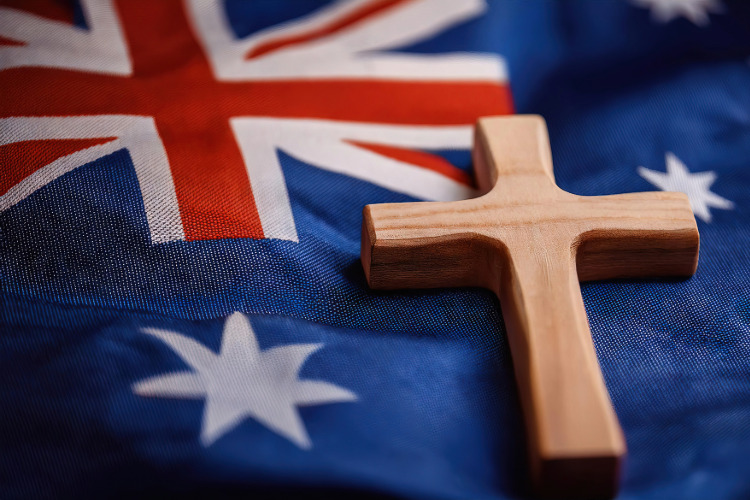
Australia is a Christian Nation

Senator Ralph Babet

31 March 2025

Australia is in the midst of a massive identity crisis. Let me explain.

We are a country founded on the Christian faith and on Western culture.

Our founding document leads with these words, ‘Humbly relying on the blessing of Almighty God.’

No one, unless you are a complete ignoramus or a member of the progressive Left, can deny that Australia is fundamentally a Christian nation.

But the Left has demonised Christianity and rejected our Western roots. So where does that leave us?

If we are not Christian… what are we?

And it’s at this point that the left shows us what nihilists they are.

They love to tear down everything that made Australia great, but they never provide an alternative.

They want to destroy our foundations only to leave us standing with our feet firmly planted in mid-air.

They are all criticism, with zero alternatives.

If we are not a Christian nation, as the Left insists, then the Left must tell us what kind of nation we are.

They’ll say we are a ‘secular’ nation, by which they mean we are anything and everything except Christian.

Is it any wonder we no longer have shared values…

And if we are not descendants of Western culture, then what culture are we?

The so-called progressive Left will proudly proclaim that we are multicultural. But what does that even mean?

Religion and Culture

Australia is Australia because it was founded by Christian people from a Christian culture.

Our political and legal systems reflect that. And I’m pretty sure that we are all glad that they do.

Consider the alternative.

We have Common Law rather than Sharia Law because we were founded by people professing faith in Jesus Christ rather than in Muhammad.

We are an egalitarian society because we were founded by people whose belief system was based on the Bible’s ethic of equality rather than on Hinduism with its caste system.

We have prosperity because we were founded by people who believe God created the world to be enjoyed, rather than by Buddhists who believe the only way to peace is to reject the material world.

Here’s something that is vital to understand. Politics is important, but it is downstream from culture. The culture determines the kind of politicians you get.

But culture is downstream from religion. The culture of a society is shaped, for better or worse, by the spiritual outlook of the populace.

Religion shapes the culture, and culture determines the politics.

Let me prove it to you.

Fairness and Justice

Our Common Law didn’t just happen out of thin air, it is based on the Bible.

It’s the Bible that revealed to us principles like the presumption of innocence, due process, and the right to be judged by a jury of your peers.

These were not ideas from the Enlightenment. These were ideas straight from the teachings of Moses.

It’s the Law of Moses that taught us that justice must be dispensed fairly, without partiality to the rich or to the poor.

And that principle was further outlined in the New Testament where the Apostle Paul taught that in Christ there is neither male nor female, Jew nor Gentile, slave, nor free – in other words … there is an equality of men before God, and therefore there should an equality of men before the law.

I could go on and on with examples of freedoms and protections that we take for granted that are all lifted directly from the Bible.

But what happens when our elites decide to reject the Bible and trash all of our institutions which are built on Christian principles? Do they really expect they can rip up the foundation without the whole house falling down on top of them?

You cannot have liberty if you do not have a population that, at the very least, respects and appreciates the Christian faith as the best worldview on which to base society.

Australia is a Christian country.

I know a lot of people on the Left will bristle at that because they don’t want to be Christian.

What they don’t understand is that it is precisely because Australia is a Christian country that not every Australian has to be a Christian.

Freedom of conscience and of belief is a Christian idea.

Radical secularism doesn’t teach that, and communism demands no faith other than blind obedience to the state.

Freedom vs Division

The paradox of a Christian country is that non-Christians should thank the God they don’t believe in, for living in a Christian country, where the idea of freedom – even freedom not to believe – is considered sacred.

Multiculturalism and multi-faith societies don’t work. They end up devouring themselves in never-ending culture wars where every issue becomes a power play.

If we want to protect everything great about Australia, then we must protect and defend our Christian identity.

If we fail to do that, then Australia will be shaped by other values, possibly by communism, possibly by something else. Either way, it is unlikely to be kind to non-believers.

When the Left demonises our Christian heritage and denies our Western cultural roots, I can hear the words of Jesus from the cross:

“Father, forgive them. They know not what they do.”

Even if you don’t believe in Christianity, you should wish that it were true since there is no fairer, just or hopeful worldview.

And even if you don’t practise Christianity, you should hope to live in a country where most people still do.

Christianity is the guarantee of liberty and prosperity for the believer, and for the non-believer.

That is why we all should have an interest in preserving our culture and ensuring that Australia remains a Christian country.

Peter and His End Times Teaching

Peter wrote: Praise be to the God and Father of our Lord Jesus Christ! In his great mercy he has given us new birth into a living hope through the resurrection of Jesus Christ from the dead, and into an inheritance that can never perish, spoil or fade. This inheritance is kept in heaven for you, who through faith are shielded by God’s power until the coming of the salvation that is ready to be revealed in the last time(1 Peter 1:3-5).

Peter wrote this letter to Christian believers living in various places, scattered throughout Pontos, Galatia, Cappadocia, Asia, and Bithynia. These were real places in the Ancient World. It’s interesting if you check Acts chapter 2 you find those same places mentioned among the many other regions, from which people had come to Jerusalem for the Jewish Feast of Pentecost. Acts 2 describes how on that day the Holy Spirit was poured out upon them.

So Peter was addressing some of those same people who had heard him proclaiming on that day some 25 or 30 years previously. These would have gone back to their homelands and no doubt bore witnesses for Jesus by the power of the Spirit where they lived.

He encouraged his readers, both Hebrew and Gentile believers, to prepare for a most important, earth-shattering event that was soon to take place. Terrible judgment was about to come on many Jews in Jerusalem and Judea. The temple and the Jewish religion known for centuries, Judaism, would be destroyed and replaced by a new creation. This would also seriously impact them and many traditional Jews where they lived.

Although Peter wrote that they were born again and their inheritance was safe in heaven, he said to them that their salvation was the future –it was ready to be revealed! When? In ‘the last time’. What?

Yes, the last time or the end of the age.  That’s not the end of history or the end of the world but the end of the Mosaic era, the Old Covenant, and the Jewish sacrificial economy. He wrote they are shielded by God’s power until the coming of the salvation that is ready to be revealed in the last time.

The New Testament teaches that salvation was not complete until the return of Christ: . . . so Christ also, having been offered once to bear the sins of many, shall appear a second time for salvation without reference to sin, to those who eagerly await Him. (Hebrews 9:28).

You see, this strongly reflects the Old Testament type of the high priest’s role on the Day of Atonement and his safe exit from the Temple to appear to those Jews who eagerly awaited him (Leviticus 16). God had accepted the sacrifice! In the same way, when our Great High Priest, Jesus, appears a second time, Christian believers are assured of their complete salvation. Until He appears again, believers are waiting.

In the gospel of Luke, we read So when all these things begin to happen, stand and look up, for your salvation is near (Luke 21:28).

‘All these things’ included Jerusalem ringed by armies, great tribulation in the land wrath against the Jews and the coming of the Son of Man in judgment. Jesus was addressing His disciples 2000 years ago (not us today). If those things did not happen then completed salvation did not happen!

If Christ did not return, then your salvation is incomplete and no one has yet gone to heaven.  Jesus had told Peter on the Mount of Olivet that all things which were written would be fulfilled when Jerusalem was destroyed and that included His coming again. See Luke 21:22: For this is the time of punishment in fulfilment of all that has been written.

Then Peter wrote: In all this, you greatly rejoice, though now for a little while you may have had to suffer grief in all kinds of trials. These have come so that the proven genuineness of your faith—of greater worth than gold, which perishes even though refined by fire—may result in praise, glory and honour when Jesus Christ is revealed. Though you have not seen him, you love him; and even though you do not see him now, you believe in him and are filled with an inexpressible and glorious joy 1 Peter 1:6-8)

Though they were excited and joyful, they would suffer for a little while until the time when Jesus was revealed. They were suffering persecution most likely from Jews who had rejected Jesus.

Peter says at the coming of the Son of Man, after ‘a little while (not 2000 years!) these believers will offer up praise, glory and honour. At His coming the dead will be raised! (1 Corinthians 15:52-53, 1 Thessalonians 4:16-17).  Their Jewish persecutors judged! This has happened long ago.

Since resurrection begins only at the Second Coming, the ‘End’, so if the Son of Man did not come no one yet has been resurrected. The dead remain in Sheol.

But, dear reader, where do you believe that you go at death? Heaven, yes!

Well, I have good news for you! Jesus DID return in clouds of God’s glory 2000 years ago and that means your salvation is complete! Sheol has been emptied.

Peter wrote, Therefore, with minds that are alert and fully sober, set your hope on the grace to be brought to you when Jesus Christ is revealed at his coming. (1 Peter 1:13)

Peter said they are to set their hope on the grace to be brought to them at the revelation of His coming. Peter expected His coming was soon for them. Do you honestly think that they were disappointed, left utterly without any hope? No grace brought to them? Of course not!

You may not have known it, dear reader, that your salvation is complete! Because He came!

Please comment

The Timing of Jesus’ Return

This article discusses what the New Testament says about the timing of Jesus’ second coming.

We are often reminded by teachers that Jesus said “about that day or hour no one knows, not even angels in heaven, nor the Son, but only the Father” (Mat 24:44) as if that should end any further discussion.

But there are a surprising number of passages referring to the timing of his coming. Let’s check them out.

First. Matthew 10:23. “But when they persecute you in this city, flee to another. For assuredly, I say to you, you will not have gone through the cities of Israel before the Son of Man comes.”

Jesus was speaking to his disciples as he sends them out to preach and heal in their mission to the Jews. 

The phrase “the Son of Man comes” is a clear reference to Jesus’ Second Coming. Jesus was telling his disciples that their mission will not be completed before his return, and that they should not be discouraged by persecution, but instead to flee to another city of Israel and continue their work. They are only to go to cities of Israel, to Jews, not to Gentiles.

This passage also emphasizes the urgency of the disciples’ mission, as they are to proclaim the gospel in all the cities of Israel before the Son of Man comes, a huge task taking several decades. The time was very short and that they must work to spread the message before it is too late for the hearers to repent and believe the gospel. We read about this activity in Acts, Paul preaching first to the Jews.

This is a 1st century Jewish setting and cannot fit any other historic period, let alone 2000 years in future.

Second. Mat 16:27-28. 27 “For the Son of Man is going to come in his Father’s glory with his angels, and then he will reward each person according to what they have done.  “Truly I tell you, some who are standing here will not taste death before they see the Son of Man coming in his kingdom.”

Jesus was speaking to His disciples and making a profound statement about His Second Coming and the final judgment. This is a 1st century setting and cannot possibly fit any other future historic period.

Though some interpret this as referring to the Transfiguration (Mat 17:1-8), where 3 disciples witness Jesus in a glorified state. That was an important preview of Christ’s role as supreme prophet and king. But there was no mention of his Return or judgment and it was only a few days after the Matthew 16 statement.

Third. Mat 23:38-39. ‘Look, your house is left to you desolate. For I tell you, you will not see me again until you say, ‘Blessed is he who comes in the name of the Lord.’

Jesus declared that the temple will be left desolate, abandoned.—a prophecy of its destruction which we know came by the Romans in 70 AD. Jesus’ body will replace the temple (see John 2:13-21).

The people of Jerusalem will not see Jesus again until they acknowledge and bless the one who comes in the name of the Lord—Jesus himself, as the One who was to return. The Jews will not recognize him as such until they use this phrase to greet him. This was spoken only a few days before they crucified him.

Fourth. Mat 24:14. And this gospel of the kingdom will be preached in all the world (Greek oikoumenē) as a testimony to all peoples (Greek ethnos), and then the end will come.

Jesus was speaking to His disciples discussing the signs of the end and His coming and on the spread of the gospel before the end of the age; the time of his return is linked to the completion of their task.

Note Strongs G3525 oikoumenē can exclude ‘whole earth’ e.g., Luke 2:1, Luke 21:26, Acts 24:5, Rom 10:18.  

Note also Strongs G1484 ethnos can meana company, troop, swarm, people group not just ‘nations’

Fourth. Mat 24:15-20:  when you see standing in the holy place ‘the abomination that causes desolation’ . . . .  then let those who are in Judea flee to the mountains . . . Pray that your flight will not take place in winter or on the Sabbath.

Jesus said the disciples would see the Abomination of Desolation the signal to get out of Judea and escape the Great Tribulation. Note the reference to Sabbath and the limits of travel—all purely a Judean context.

Fifth. Mat 24:32-34. “ . . . . lesson from the fig tree: As soon as its twigs get tender and its leaves come out, you know that summer is near. Even so, when you see all these things, you know that it is near, right at the door. Truly I tell you, this generation will certainly not pass away until all these things have happened.

‘All these things’ they see include the Abomination of Desolation, the Great Tribulation, the destruction of the temple and the sign of the Son of Man in the heavens and his return must have happened. If they did not happen then Jesus was at best mistaken (a decision reached by C S Lewis) or worse a false prophet.

The word ‘near’ and the phrase ‘right at the door’ can only mean his coming was quite imminent. It cannot possibly mean centuries in the future. It must be within the generation of his hearers, the disciples.

Sixth. Mat 24:44. “about that day or hour no one knows, not angels . . . nor the Son, but only the Father”

Notice Jesus used the terms hour or day of his coming—not that year, century or millennium.

Seventh. Acts 1:10-11.  After he said this, he was taken up before their very eyes, and a cloud hid him from their sight. They were looking intently up into the sky as he was going, when suddenly two men dressed in white stood beside them. The two men in white said to the disciples “This Jesus, who has been taken up from you into heaven, will come in just the same way as you have watched Him go into heaven.

taken up before their eyes into a cloud: They quickly lost sight of him straining to see him, because it was not a rain cloud but a cloud of God’s glory—see Dan 7:13, Mat 17:5-8, 24:30, 26:63-64;, Rev 1:7, Rev 11:12.  

just the same way as: This Greek construction occurs in Mat 23:37. Greek tropos: like as, in the same way.

How often I have wanted to gather your children together as a hen protects her chicks beneath her wings . . .

Jesus said he was like a hen–not a hen! Jesus’ return is similar to his departure. He disappears in the cloud and when he returns he will come hidden in clouds of God’s glory, clouds hiding him like when he left.

When he came in judgment destroying the Temple he came in the clouds, just as He promised (Mat 24:30), and just as the same clouds of glory that shrouded Him as He ascended. Why should people  believe that he could be seen bodily, he who dwells in the splendour and glory of Almighty God?

This passage strongly suggests that his coming was to occur within the lifespan of those present. His coming is not a “coming” that will occur in our future, for indeed, it has already occurred.

How could the apostles be so sure?

There are over one hundred passages in the apostles’ letters showing how the first believers were more than confident of his return in their lifetime. Just as these ‘timing’ passages confine Christ’s Second Coming to the first-century generation, they saw the end of the age squarely in that generation as well. See e.g.

-Phil 3:20.  . And we are eagerly waiting for him to return as our Savior.

-Titus 2:11f. we wait for the blessed hope—the appearing of the glory of our great God and Savior, J

-2 Thes 2:1.  . .  about the coming of our Lord Jesus Christ and how we will be gathered to meet him.

James 5:8-9. You too, be patient and stand firm, because the Lord’s coming is near. Don’t grumble against one another, brothers and sisters, or you will be judged. The Judge is standing at the door!

I conclude: Jesus must have already returned!  Please comment and explain if you are unconvinced

The Man of Lawlessness

Introduction

Shortly after writing 1 Thessalonians, the apostle Paul received a report (2 Thess. 3:11) that the Thessalonian church had accepted the strange claim that “the day of the Lord has come” (2:1–2). Paul sent them a second letter in A.D. 49–51. He was probably in Corinth at the time. This letter was addressed to the Thessalonians.2000 years ago when these people and Paul were expecting Jesus’ imminent return in their lifetime. It was seriously relevant to the Thessalonians. It is not relevant for us as 2000 years have passed but it useful for our studies and the truth is always relevant.

2 Thessalonians 2:1-9

  1. Now, dear brothers and sisters, let us clarify some things about the coming of our Lord Jesus Christ and how we will be gathered to meet him.
  2. Don’t be so easily shaken or alarmed by those who say that the day of the Lord has already begun. Don’t believe them, even if they claim to have had a spiritual vision, a revelation, or a letter supposedly from us. 3 Don’t be fooled by what they say. For that day will not come until there is a great rebellion against God and the man of lawlessness is revealed—the son of destruction.

Paul here assured the Thessalonians that a great rebellion against God and therevealing of a man who opposes God and exalts himself above everything that is called God must occur before Jesus’ return. Jesus told the disciples in the Olivet discourse (Mat 24:10-12) about this falling away.

4 He will exalt himself and defy everything that people call god and every object of worship. He will even sit in the temple of God, claiming that he himself is God.

Paul described this “man of lawlessness” as being empowered by Satan, performing signs and wonders, and deceiving many (verse 9).

Who was this son of destruction? Was it the Roman general Titus who entered the Jerusalem temple?

Josephus wrote that Titus entered the Holy of Holies with his generals in A.D. 70. (Wars, 6.4.7.) Shortly thereafter, Titus was worshipped in the Temple as was customary of someone declared imperator. As Josephus wrote, “And now the Romans . . . brought their ensigns to the temple and set them over against its eastern gate; and there did they offer sacrifices to them, and there did they make Titus imperator.”(Wars 6.6.1)  A metallic image of Vespasian and Titus was also worshipped at that time. Images of the emperor and his favourites were regularly attached to the Roman ensigns at that time. 


5. Don’t you remember that I told you about all this when I was with you? And you know what is holding him back, for he can be revealed only when his time comes.

Jesus had spoken about these things to the disciples in the Olivet discourse, Matthew 24:15-16: “So when you see the Abomination of Desolation spoken of by the prophet Daniel, standing in the holy place, then those who are in Judea must flee to the mountains”. Daniel, during the Babylonian captivity, had written about this happening just before His return. Jerusalem and the temple were to be destroyed and countless numbers of Jews would perish at the hands of the Romans.

Paul had told the Thessalonians about all this when he visited them previously. They already knew so he didn’t have to repeat what he had said. But Paul didn’t repeat it in this letter so it is difficult for us to know what was ‘holding him back’ from his appearing. We are left to assume that Paul never bothered to record this information in writing.


7 For this lawlessness is already at work secretly, and it will remain secret until the one who is holding it back steps out of the way. 8 And then the lawless one will be revealed, whom the Lord Jesus will overthrow with the breath of his mouth and destroy by the splendour of his coming. 9 The coming of the lawless one will be in accordance with how Satan works. He will use all sorts of displays of power through signs and wonders that serve the lie

Paul wrote to them about this lawlessness being already at work—the hidden, evil Satanic forces at work in the world opposed to God and His people.

So who or what is the one holding the man of lawlessness back? Many attempts have been made to identify this person or entity.

I believe the only possible explanation is that God is the restrainer, as He is the only one who can restrain Satan. God restrains evil and eventually turns unrepentant sinners over to indulge in evil (Romans 1:20-24, 26, 28). And Job reveals that God prevents Satan from certain activities (Job 1:10-12). Only God can restrain evil and the man of lawlessness.  

Paul said the one who is holding it back would step out of the way. When that would occur then the man of lawlessness would be revealed and the Lord Jesus would overthrow him and destroy him by the splendour of his coming. 

But does it really matter that we today know the identity of the one who Paul believed restrains him? That wasn’t Paul’s issue in this letter. His concern was that the Thessalonians were worried they had missed the Lord’s coming and to reassure them that they would not miss out.

We may be curious of course. And for those today, even after 2000 years, who believe the Satanic lie that Jesus is yet to return, it arouses a lot of comment. The man of lawlessness has indeed been revealed and the Lord Jesus long ago overthrew him.

The Mystery of Israel — a film

This is a film by David Sorensen he made very soon after the attack by Hamas upon Israel on 7th October 2023. I urge you to watch it and refer it to others. See at https://stopworldcontrol.com/israel/

This will open your eyes to what is happening behind the scenes.

It is important for us not to take sides. We need to pray for the ceasing of all hostilities and for innocent civilians to be protected and even more for them to experience our Lord Jesus at this time.

To Whom Do You Listen?

This article is by my good friend Jane Blakey

To whom then shall we listen?

We all remember this. 
Jesus took with Him Peter and James and John, and led them up to a high mountain by themselves. And He was transfigured before them, and His clothes became radiant, intensely white, as no one on earth could bleach them. And there appeared to them Elijah with Moses, and they were talking with Jesus.
And Peter said to Jesus, “Rabbi, it is good that we are here. Let us make three tents, one for you and one for Moses and one for Elijah”.
For he did not know what to say, for they were terrified.

‘And there was a cloud that overshadowed them: and a voice came out of the cloud, saying, This is my beloved Son: hear Him‘. (Mark 9:2-7)
Not to Moses AND Elijah AND Jesus.
But, listen to Jesus! Hear Him.

Over this weekend, I have been thinking very much of the New Jerusalem, the city that has foundations that Abraham looked forward to. That one whose designer and builder is God. That better country, a heavenly one where God has prepared a city. (Hebrews 11: 8-16)
I am thinking of the promises made to Abraham and his offspring – to one. To Jesus, the seed  of Abraham – and of those who are Christ’s and who thereby are Abraham’s offspring, heirs according to promise. (Gal 3:16 & 27-29).

My thoughts are on the two Jerusalems: Mt Sinai in Arabia that corresponds to the earthly Jerusalem who is in slavery and of the one who is our mother – the Jerusalem above that is free (Gal 4.:22-31, especially 25 & 26).
THIS is the city and the better country that Abraham was looking for; the city of his seed Jesus and of Abraham’s descendants – those who are in Christ.
Here, ‘there is neither Jew nor Greek, there is neither slave nor free, there is no male and female, for you are all one in Christ Jesus’. 
(Gal.3:28)

When Jesus met the Samaritan woman at the well, HE said to her:
‘Woman, believe me, the hour is coming when neither on this mountain NOR in Jerusalem will you worship the Father. But  the hour is coming and is NOW here, when true worshippers will worship the Father in Spirit and truth, for the Father is seeking such people to worship Him. God is Spirit and those who worship must worship in spirit and truth.’ (John 6:21-24)

There is almost an obsession in some Christian circles with the earthly city of Jerusalem and the land. 
Yet, how can there be a mixture of that which is of the Old Covenant and that which is of the New Covenant? This was anathema for Jesus. His analogies were stark!

“And no one pours new wine into old wineskins. If he does, the wine will burst the skins, and both the wine and the wineskins will be ruined. Instead, new wine is poured into new wineskins.” (Mark 2:22)

And again; “No one sews a patch of unshrunk cloth on an old garment. For the patch will pull away from the garment, and a worse tear will result.” (Matthew 9:16)

Paul perhaps was even blunter.
For Paul, the earthly Jerusalem was represented by Hagar and the one who was born of the flesh who persecuted the one who was born of the Spirit. Paul exhorted the believers in Galatia to do this: ‘Cast out the the slave woman and her son, for the son of the slave woman shall not inherit with the son of the free woman. So, brothers and sisters, we are not children of the slave but of the free woman’.’

There seems to be confusion in the Christian church. A confusion of Covenants.
To whom do we belong and where is our city?
It is the city Abraham was seeking, the city of Godthe HEAVENLY Jerusalem! The words of our Lord and God Jesus and the thoughts and writings of that great theologian Paul are profound truths.

Simple, Biblical Christianity.

Much love dear friend.
Jane.

The Olivet Discourse: Matthew 24:1-9

Let’s begin our journey through Matthew chapter 24. Did you read Matthew chapters 21 to 23 to get the overall context–the lead up to Matthew 24, the Olivet Discourse?

  1. Jesus came out from the temple and was going away when His disciples came to point out the temple buildings to Him.

the temple buildings: Mark (13:1) notes that one of the disciples exclaimed “Teacher, what wonderful stones and what wonderful buildings!” This complex took 46 years to build (John 2:20) and was one of the wonders of the ancient world. It was built of stones weighing up to 400 tons and was capable of accommodating up to one million people. Think about that.

2. And He said to them, “Do you not see all these things? Truly I say to you, not one stone here will be left upon another, which will not be torn down.”  

  • Truly: Amen!Jesus often used this word when about to say something extremely surprising and unbelievable—as if to warn them they were about to be shocked—see v.34. And so this event was the most shocking and tumultuous thing any Jew could imagine would happen. This struck at the very heart of Judaism, their religion, God’s house. This was unimaginable, incredible, beyond belief.
  • you: 2nd person, plural—these disciples are specifically addressed here and throughout this discourse and not for people of future times. Jesus provokes these disciples to ask questions.
  • not one stone: The destruction of the temple will happen because it was now no longer God’s house, but ‘desolate’ (Mat 23:38) and by then Jesus would have made the sacrifice once for all (Hebrews 10:9, 12, 14, 18). See also Jesus’ words recorded in Luke 21:24. The Roman army under Titus destroyed the temple in 70 AD along with the city of Jerusalem.

3.  As He was sitting on the Mount of Olives, the disciples came to Him privately, saying, “Tell us, when will these things happen, and what will be the sign of your coming and the end of the age?”

  • on the Mount of Olives: After ascending the mount they would have a clear view of the subject of Jesus’ shocking prophecy.
  • privately: Mark wrote that Peter, James, John and Andrew were present (Mk 13:3). Luke identified the questioners as ‘they’ who were some of those who admired the temple area (Luke 21:5-6). Jesus spoke these words to people in his generation, not future generations.
  • So the disciples had two questions for Jesus: a ‘when’ question about the destruction of the Temple buildings, and a ‘what’ question about ‘his parousia’ and ‘the end of the age’ which are inseparably bound in one sign (singular) to come.
  • coming: (Grk ‘parousia’) means ‘presence’, a period, a state, not an action—Strong’s G3952. The word implies a visit or visitation and this one is of judgment and wrath. It is also for His people a coming to be present with them—God with them! Abiding in us!
  • age: Grk aionos, not ‘kosmos’ world as in KJV. This is about the end of an age, the Mosaic age, the old covenant age—here and in the other occurrences of this phrase in this discourse. See 1 Cor 10:11—Paul wrote about his age which was already at an end. Hebrews 9:26 says ‘Jesus appeared at the end of the age, to put away sin.’  Jesus first coming was a past event, marking the beginning of the end of a period, the end of the Jewish or Mosaic age.
  • The term ‘the end’ is repeated in vs. 4, 13, 14, so it is critical to know what is meant by ‘end’.
  • Their questions used the terms ‘parousia’ and ‘end of the age’ as Jesus had already taught the disciples about his coming and the replacement of the current age (see Mat 16:27-28).
  • The discourse that follows vss.4-36 must be seen as Jesus answering the disciples’ two questions—when these things will happen and what will be the sign of His presence. The central issue is Jesus’ coming in judgment on Israel and the Temple which no longer was fit for his presence among them and his parousia (presence) among a new ‘nation’ of the elect.   

4. Jesus answered them “See to it that no one misleads you.

  • Jesus warned them—they were likely enough to be misled. We can be misled too if we think these words are addressed to us!

5. For many will come in My name, saying, ‘I am the Christ,’ and will mislead many.

  •  The times were awash with end-of-age and coming of Messiah beliefs, Josephus talks about these in his Jewish Wars 9:3’.

6. You will be hearing of wars and rumours of wars. See that you are not frightened, for those things must take place, but that is not yet the end.  

  • Today end-time preachers use these texts to frighten people that his return is near. But It is clear Jesus was prophesying here to his disciples, not to 21st Century readers. It is nonsense to hold that what was ‘near’ for these disciples (‘you’) can be ‘near’ for us today.
  • At the Jewish council, Gamaliel mentioned uprisings led by Theudas and Judas of Galilee (Acts 5:35-38).
  • Jesus here dealt with the ‘when’ question and continues this until at least verse 15.

7. For nation will rise against nation, and kingdom against kingdom, and in various places, there will be famines and earthquakes.

  • nation against nation: See Josephus Jewish Wars, b. 6, 9:3. Coffman concludes “Such things as famines, wars, and earthquakes seem to have been multiplied during that period”. Also Albert Barnes Commentary
  • earthquakes: John Gill comments that “at Crete, and in divers cities in Asia in the times of Nero: particularly the three cities of Phrygia, Laodicea, Hierapolis, and Colossae; which were near to each other, and are all said to perish this way, in his reign.”

8. But all these things are merely the beginning of birth pangs.

  • birth pangs: Jesus had spoken to these disciples of ‘the regeneration (Grk, ‘paligenesia’= rebirth, renewal) when the Son of Man will sit on His glorious throne (Mat 19:28, Luke 22:28) as pictured in Daniel 7:13-14, and following his ascension into heaven (see Acts 2:33-36)—not in any worldly ‘millennium’ as taught by many endtime teachers. These disciples will live through all these things—this is just the beginning of birth pangs.
  • But they are not to fear, as something much, much more heavenly and serious will happen.
  • Jesus continues warning them not to be misled. Political conflicts, famines and earthquakes have been commonly reported in history and preachers then and today have often used current troubles in to convince hearers of the imminent end of the world.

9. “Then they will deliver you to tribulation, and will kill you, and you will be hated by all nations because of My name.

  • Then:here is one of several time stamps e.g., v.10, which show that the narrative is a unity.
  • Deliver you: Jesus was prophesying to those who asked the questions not to us today. This was part of the disciples’ inevitable sufferings “because of My namewe find recorded in Acts and epistles and foreshadowed in Mat 23:34.
  • Tribulation: The word tribulation or suffering is used multiple times in the NT, and here is not connected to the “great tribulation” Jesus would refer to in v.21.
  • all nations: Strongs 1483 (ethne); better translated ‘multitudes’ including Jews and Gentiles.

To be continued . . . .

OH, THAT WRETCHED WORD ‘CHURCH’

English translators of the scriptures saw the New Testament with religious (catholic) lenses. So these obeyed the politico-religious powers and consistently translated the Greek word ekklesia into a current religious word, ‘church’ which everyone already knew, being taught and accepted as truth, instead of the real meaning of the Greek word, which is assembly or gathering—a word in the Ancient World which had no religious or institutional connotations at all. None.

This is clearly shown by the translators’ inconsistency in translating the same Greek word by assembly or gathering three times in Acts 19—the story of Paul’s gospel stirring up the silversmiths in Ephesus—instead of the c… word! Check me out. I kid you not.

Ekklesia always meant assembly or gathering in the Ancient World of the New Testament period. When Paul wrote to those gatherings of Jesus’ people in the New Testament period, he qualified the word ekklesia by e.g., the ekklesia in God the Father and His son at . . . . (wherever—Corinth, etc) or similar language. It had to be distinguished from all the other local gatherings—religious, political or commercial which abounded in great numbers.  Get it?

And if Paul was talking about more than one gathering of believers, he used the plural, ekklesiai, gatherings. So we read about the “assemblies or gatherings of Judea” and not “the gathering of Judea”. John does not address any “assembly of or in Asia” in the Book of Revelation but as “the seven gatherings in Asia”. Seven! And that’s because they are assemblies not denominations or institutional religious organisations.

In fact, a strong case can be made that ekklesia originally meant “a gathering actually gathered” so that when the assembly broke up there was no longer a gathering. For example the riotous assembly, Acts 19:41. Naturally for a group of believers meeting regularly it would continue in their minds as a spiritual gathering, a virtual one, which had a (hopeful) continuity while not meeting—though could never be guaranteed that it would gather again exactly the same as it did the previous time.

So it’s like our parliaments which sit for a period but then when not sitting, there is no parliament. And a city council is really only a council when it is meeting. The employees are not the actual council, are they?

William Tyndale in his groundbreaking 16th Century English New Testament translation, rendered ekklesia as ‘congregation’ which then had no traditional religious connotation. This led to his being persecuted and strangulated by the religious establishment—that’s 1534 English history.

So why did the English Bible translators three times translate ekklesia as ‘assembly’ in the story in Acts (Acts 19:32, 39, 41)? The word church clearly wouldn’t fit these three meeting contexts. But wearing their religious glasses, they consistently translated the Greek word in other contexts as ‘church’ as if this Roman Catholic term was its equivalent and not as the word was understood in the Ancient World.

A century later, the translators of the King James Version (KJV)  were commanded by James the King of England to abide by about 14 conditions one of which the Greek word ekklesia had to be translated as church. They had no option but to do what James wanted so he could maintain his political agenda. They did translate the word as assembly in the Acts 19 story.

You may be interested to know that now we can use a recent scholarly translation called World English Bible (WEB) which translates the Greek word ekklesia with the English word assembly in the New Testament. In this version, the word ‘church’ cannot be found.

What has kept English translators so long to correct this?

Tradition! which obscures the word of God.

We may ask: why did the apostles use the Greek word ekklesia (gathering) and not other words which had a similar meaning? They did not use the word synagogue for the obvious reason that their gatherings were distinguished from those of the Jews.

Now, the Hebrew word qahal (=gathering, assembly) had been used in the Old Testament over 100 times and in the Greek translation of the OT (called the Septuagint or “LXX”) this Hebrew word was translated ekklesia (gathering). The early New Testament writers widely used the LXX and so probably chose this word which was also used by Jesus (see Matthew 16:18 and 18:17—the only places in the 4 gospels).

Simplicity: Hold fast what you received

How simple it all is!

But so much has been added to the simplicity of Christ and as a result, that simplicity has disappeared.

In robbing us of that simplicity and embracing instead the religious ideas of human thinking, what has not been given to us, we have lost just about all.

I invite you to consider with me the utter simplicity of what was revealed to the first communities of Jesus.

For starters, consider these words from the mouth of Jesus to believers recorded for us in the book, Revelation.

 “To the angel of the church in Ephesus . . . . . ‘You have forsaken the love you had at first. Consider how far you have fallen! Repent and do the things you did at first.’” Rev 2:4-5.

“I say to the rest of you in Thyatira ‘I will not impose any other burden on you, except to hold on to what you have until I come.’”  Rev 2:24-25

 “To the angel of the church in Sardis write  . . . . . . ‘I know your deeds; you have a reputation of being alive, but you are dead.  Wake up! Strengthen what remains and is about to die, for I have found your deeds unfinished in the sight of my God.  Remember, therefore, what you have received and heard; hold it fast, and repent. But if you do not wake up, I will come like a thief, and you will not know at what time I will come to you.’”  Rev 3:1-3.

And “To the angel of the church in Philadelphia . . . .  ‘I am coming soon. Hold on to what you have, so that no one will take your crown.’” Rev 3:1, 11

Consider also these words from the pen of apostle John . . .

Let what you have heard from the beginning abide in you. If what you have heard from the beginning abides in you, you will abide in the Son and the Father. 1 John 2:24

Need I comment?

Dare I comment?

If you have ears to hear, then please join me in hearing, that is, obeying.

One Together in God and His Christ

Having prayed to the Father first for his disciples that they may be one “as We are”, Jesus then prayed for those who will believe in Me through their word; that they all may be one, as You, Father, are in Me, and I in You; that they also may be one in Us, that the world may believe that You sent Me (John 17:20-23). He therefore prays for you and me —we believers are included in His prayer and ongoing intercessions!

So what is He praying for us, we who have believed in Him through their word? The answer follows with some staggering ‘purpose clauses’. In this post, we look at the first of these.

That they all may be one, as You, Father, are in Me, and I in You;

This is the same request he made for the original disciples: that they may be one “as we are”, the Father in Jesus and Jesus in the Father. This is undoubtedly the will of God for you and me, for all followers. Nothing has changed, though we have changed and not for the better.

We are thus connected to the original disciples in the Spirit by the same will of God in Christ! We are meant to be together with them, immersed in the Father, Son and the Holy Spirit. No change!  There is no change in covenantal privileges and responsibilities from them to us despite the passage of 2000 years. We live in the fellowship of the saints!

This awesome connection, oneness, S. Paul calls the Body of Christ. Jesus calls it My ekklesia.

This is of critical importance in how we understand our relationship with other believers, and how we look at ekklesia. That’s the original word used and badly translated into English as church, where it comes across as a religious concept. The word ekklesia in the original simply meant a gathering of people for a purpose. It had no religious connotation whatsoever. None.

The only ekklesia that is actually of God is the one Jesus is constructing—Matthew 16:18. Humans cannot build this. And we must not try. We are not commanded to do so.  And yet we fail to do what we are instructed—to bring in the harvest, to teach others to be disciples, to love one another and to be ONE together as You, Father, are in Me, and I in You.

But we can be so busy trying to help Him build churches, we fail to experience the glory He wants to display in us. He, not us, is the Architect and the Builder of His ekklesia. We are together members of His glorious Body, the living stones in this spiritual building. Together in Him.  ONE.

And in this glorious fellowship, this temple of God, we are to be one together. One not many.

Jesus’ prayer for you and me, all believers, constantly before the Father, is for our oneness. Do you see that excludes so much activity taken for granted in today’s religious organisations? Thus denominational exclusiveness is a grave error. Control of others is anathema. Selfishness, vainglory, hatred, self-righteousness, arguments, self-justifications, dogmatism causing splits, must all be thrown out.

When we are united together in actually doing what he has commanded—rather than what our precious theology or doctrines or opinions or religious organisations want—when we are abounding in the actual work of the Lord, filled with the Holy Spirit, bearing witness to Him, participating in the making of disciples, reminding, teaching, urging, persuading, encouraging others—in our joy and gladness in serving Him and one another, we leave behind those obstacles to oneness.  We forget our own agendas in favour of His agenda—our ONENESS.


It’s not about you. It’s not about us. It’s all about the Father and His Christ. Right?